Image Of The day

See the newest image from scientist ultra advanced device

Planck Image Of The Early Universe

The color-coded image is effectively a photograph of the universe when it was only 379 000 y old,which was about 13.7 billion years ago. An amazing picture from the universe

Two colliding galaxies

The colliding galaxies NGC 4676 leave a trail of stars, this image was taken by Hubble Space Telescope

Earth seen from Appllo Moon landing mision

Space Exploration in the middle 20th century increasing human knowledge to new era science

CERN Large Hadron Collider tunnel

Huge particle smasher, like LHC is a gigantic and complex engineering marvel that disigned to detect particles at extreme energies

Hubble Space telescope seen from last service

Multi billion dollar device like HST can brings very deep image from the heart of the universe

Friday, December 16, 2011

Scientists find answer to supernova riddle


The discovery of a supernova only hours after its explosion has probably solved a long-standing mystery on the origin of the brightest known phenomena in the Universe, scientists reported Wednesday.
On August 24, scientists witnessed the spectacular eruption of light and energy thrown off by the birth of SN 2011fe, the brightest and -- at a mere 20.9 million light years away -- closest-to-Earth supernova in over 25 years.
One light year is the distance that light travels in 365 Earth days, about 9.46 trillion kilometres or 5.87 trillion miles.
"We caught the supernova just 11 hours after it exploded, so soon that we were later able to calculate the actual moment of the explosion within 20 minutes," said Peter Nugent of the US Lawrence Berkeley National Laboratory and lead author of one of two studies, both published in Nature.
"With this close-up look, we found things nobody had dreamed of," he said in a statement.
Brightness thrown off by the violent stellar blast of type 1a supernovas is the yardstick for measuring distances across space.
This was crucial in this year's Nobel Prize winning discovery that the expansion of the Universe is accelerating and not slowing down, as once thought.
Up to now, astronomers had advanced three competing scenarios to explain the origin of 1a supernovas, rare events that only happen once every couple of hundred years in a galaxy such as our own.
In all three, a so-called white dwarf -- an ageing star in decline -- steals matter, and energy, from a companion star until the white dwarf explodes in a flash a billion times brighter than our Sun.
A supernova is so powerful it can outshine an entire galaxy such as the Milky Way, which contains some 200 billion stars, for several weeks.
White dwarfs are essentially Earth-sized diamonds. A single tablespoon weighs about ten tonnes.
Most white dwarfs die not with a bang but a whimper, gradually leaking away heat over billions of years.
But a few interact with other stars to create supernova detonations that are, in essence, colossal thermonuclear explosions.
The question was this: what species are these progenitor companion stars that feed white dwarfs until they burst?
Candidates included a red giant, a second white dwarf, and a so-called subgiant star, of which our Sun is a specimen.
By looking at pre-blast images captured by the Hubble Space Telescope, one team of scientists led by Li Weidong was able to exclude the red giants, which are 10,000 times more luminous that the Sun.
They were not, however, able to narrow things down more.
Nugent's team, which observed SN 2011fe exploding in the Pinwheel Galaxy from the California's Palomar Observatory, took the analysis a step further.
Sifting through the spectrum of the supernova as it expanded, they determined that the companion start was most likely a subgiant, also known as a main-sequence star.
"If there was a giant companion star orbiting nearby, we should have seen some fireworks when the debris from the supernova crashed into it," said co-author Daniel Kasen, a professor at the University of California at Berkeley.
"Because we didn't observe any bright flashes like that, we determined that the companion star could not have been much bigger than our Sun."
"Although the studies do not yet provide a definitive answer to this question, they are a reassuring step forward," said Mario Hamuy, in a commentary, also published in Nature.
But scientists may have to wait another 30 years before another supernova explodes in our neighbourhood or, if we are lucky, in our very own Milky Way, he said.

Tuesday, December 6, 2011

Why has Britain done a U-turn on plutonium?


Why does the UK government want to convert its 112 tonnes of plutonium — the largest civilian stockpile in the world — into mixed-oxide fuel (MOX), when just a few months ago it announced the closure of the only MOX production facility in the country because of a lack of demand? Energy minister Charles Hendry announced last week that converting the plutonium to MOX was still the plan, but a new £3-billion (US$4.7-billion) plant would only be built if it could be shown that it was both affordable and offered value for money.
Although at first glance this may seem fiscally prudent, when taken with other recent events it starts to look nonsensical. Just a few weeks ago, the Nuclear Decommissioning Authority (NDA), responding to the government’s own request to consider how to deal with the stockpile, advised that the cost of making MOX is greater than its value as a fuel. And therefore, the most cost-effective plan would be to continue storing the plutonium until a geological disposal facility becomes available for it to be buried underground. So what’s going on? To make sense of it all, Nature peers through the looking glass of the British nuclear industry.

Why would the UK government want to reprocess plutonium into fuel?

Partly, because the plutonium is a huge embarrassment. To continue storing it is not only a constant reminder of how ill-thought-out British nuclear policy has been over the past decades, but it also poses a risk to non-proliferation. So converting it into MOX would transform a huge pile of waste — which the NDA euphemistically calls a “zero value asset” — into something potentially useful, while making the plutonium far harder to weaponize were it to fall into the wrong hands.

So why is it closing the only plant that can do that?Ostensibly, because, in the wake of the Fukushima nuclear disaster, the Sellafield MOX Plant no longer has any customers. But in truth it never really worked. It was built to convert the UK plutonium stockpile into MOX, but, having been plagued by technical failures and delays, it has managed to produce only around 2.5% of its intended quota since it started operating ten years ago. With such a low throughput, it would have been unable to convert the UK stockpile fast enough to provide MOX for new reactors. And so in 2010 the NDA did a deal with ten Japanese utility companies to process their smaller amounts of plutonium and supply them with MOX, a deal that ultimately sank beneath a tsunami.

Why build a new one?


Because the problem hasn’t gone away. Britain still needs to get rid of the plutonium and, despite the failings of the Sellafield plant, MOX production is a proven technology. The one other plant in the world, the Melox plant in Gard, France, has produced around 1,700 tonnes of MOX since it was built in 1995. So, currently, the only other options are to do nothing — keeping the plutonium in storage until geological disposal becomes possible sometime after 2075 — or to process it so that it can supply a fast reactor, such as the kind that, with almost comic timing, GE Hitachi offered to build at Sellafield last week. The problem with this is that, despite 30 years in development, these reactors are still an unproven technology.

Is it worth it?

According to the NDA, not if you care about making a profit. With the low cost of uranium and the high cost of producing MOX, the reprocessed fuel would probably have to be given away. But profit isn’t everything. Indeed, as long-term plutonium managing solutions go, MOX production gets the NDA’s backing. And that is the message Hendry is putting out, that although the government is not quite ready to do anything with the plutonium yet, when it is ready it will be taking the MOX route. And if that means not making a profit, that’s a small price to pay for getting rid of such an albatross. It’s a brave decision, and one that gets the backing of both the Royal Society and the government’s former chief scientific adviser David King at the University of Oxford’s Smith School of Enterprise and the Environment. 

Will it ever actually happen?

Despite all the caveats, we could see a MOX plant approved sooner rather than later. Tied into the decision is a proposal for Britain’s next-generation reactors, which would use MOX as fuel, thereby requiring a MOX plant to be in production before they come online. What remains to be seen, however, is whether a new MOX plant will be able to show that the UK nuclear industry has learnt from the mistakes and failures of the Sellafield plant and to get rid of the plutonium once and for all.

Walk-Through-Wall Effect Might Be Possible With Humanmade Object, Physicists Predict


Tunnel vision. A superthin sheet of carbon atoms suspended could quantum tunnel between two positions, one slightly bowed and one so bent it contacts the metal plate. An atomic force microscopy image of a graphene membrane (inset) 

If you've ever tried the experiment, you know you can't walk through a wall. But subatomic particles can pull off similar feats through a weird process called quantum tunneling. Now, a team of physicists says that it might just be possible to observe such tunneling with a larger, humanmade object, though others say the proposal faces major challenges.
If successful, the experiment would be a striking advance toward fashioning mechanical systems that behave quantum mechanically. In 2010, physicists took a key first step in that direction by coaxing a tiny object into states of motion that can be described only by quantum mechanics. Tunneling would be an even bigger achievement.
So how does quantum tunneling work? Imagine that an electron, for example, is a marble sitting in one of two depressions separated by a small hill, which represent the effects of a sculpted electric field. To cross the hill from one depression to the other, the marble needs to roll with enough energy. If it has too little energy, then classical physics predicts it can never reach the top of the hill and cross over it.
Tiny particles such as electrons, however, can still make it across even if they don't have enough energy to climb the hill. Quantum physics describes such particles as extended waves of probability—and it turns out that there is a probability that one of them will "tunnel" through the hill and suddenly materialize in the other depression, even though the electron can't occupy the high ground between the two low spots.
It sounds unlikely, but scientists and engineers have amply demonstrated quantum tunneling in semiconductors in which electrons tunnel through nonconducting layers of material. (In fact, some types of magnetic hard drives rely on tunneling for reading out data.) And the Nobel Prize-winning scanning tunneling microscope relies on electrons tunneling through a forbidden no man's land between a tiny fingerlike probe and a conducting surface. Still, no one has ever seen a macroscopic object tunnel through an obstacle.
But Mika Sillanpää and colleagues at Aalto University in Finland say it might be possible to do just that using a tiny widget that resembles a trampoline as they reported 8 November in Physical Review B. Researchers would fashion the micrometer-wide trampoline out of graphene, a superstrong, superflexible sheet of carbon only one atom thick. They would suspend the membrane—small but much larger than the atoms and molecules that are the usual domain of quantum physics—over a metal plate. When experimenters applied an electrical voltage, the membrane would have two stable positions: one in which it bows slightly in the middle and one in which it bends enough to contact the plate below. In the Finnish team's design, the electrical and mechanical forces on the membrane create an energy barrier between these two positions. If researchers could lower the membrane's energy by cooling it to a temperature of less than a thousandth of a degree above absolute zero, then the only way it could get between the two positions is quantum tunneling. The experimenters could then observe the membrane's change of configuration by looking for a change in the system's capacitance, a measure of how well it can store electrical charge. Sillanpää says achieving the low temperatures required may take several years, but the team is moving forward with an experiment.
Quantum tunneling in a mechanical system is "the kind of holy grail that people are looking for now," says physicist Walter Lawrence of Dartmouth College, but the experiment is likely to be difficult. Gil-Ho Lee, a physicist at Pohang University of Science and Technology in South Korea, says the proposed experiment would be an important first step toward demonstrating quantum tunneling. But he cautions that it might not be conclusive because the membrane might perform similar flip-flops when it absorbs a little extra energy in the form of heat. "A more sophisticated test must be done," Lee says. He says that searches for quantum tunneling in electrical systems known as Josephson junctions faced similar issues in the 1980s before experiments eventually confirmed tunneling.
So why can't you use quantum tunneling to walk through a wall? Quantum mechanical calculations show that for something as big as a person, the probability is so small that you could wait until the end of the universe and most likely still not find yourself on the other side.

The Physics of Wine Swirling


Meet the new flavor of wine: fruity with a hint of fluid dynamics. Oenophiles have long gotten the best out of their reds by giving their glasses a swirl before sipping. A new study has revealed the physics behind that sloshing, showing that three factors may determine whether your merlot arcs smoothly or starts to splash.

Twirling a wineglass gently creates smooth arcs in the liquid that then circle, coating the sides of the glass. The gesture isn't just for appearances, says study co-author Martino Reclari, who studies fluid dynamics at the École Polytechnique Fédérale de Lausanne in Switzerland. Scientists and enthusiasts alike have long known that the swirling motion mixes oxygen into a red, enhancing its flavor.

One evening over their own bottle of wine, Reclari and colleagues decided to tackle the physics of this oenological routine. The team filled up small cylinders in a range of sizes with different volumes of a cheap merlot, then set them spinning. To keep things uniform, the researchers employed gyrating machines, commonly used to mix liquids precisely in biology or chemistry labs. This week, at the annual meeting of the American Physical Society's Division of Fluid Dynamics in Baltimore, Maryland, the group reported a mathematical formula explaining how wine sloshes.

Unlike the flavor of a perfectly aged pinot, Reclari says, the factors at play aren't overly complicated. Three factors seemed to determine whether the team spotted one big wave in the wine or several smaller ripples: the ratio of the level of wine poured in to the diameter of the glass; the ratio of the diameter of the glass to the width of the circular shaking; and the ratio of the forces acting on the wine. Those forces affecting the wine were the centrifugal force pushing the liquid to the outside of the glass and the gravitational force shoving the liquid back down.


By tweaking these factors a notch—for instance, by pouring a bit more wine into a glass or shaking that glass in tighter circles—Reclari and colleagues mastered the art of unusual wine waves. Their creations in the video above included the wine lover's standard, a single, smooth crest, all the way to four miniwaves that built in quick succession. Curiously, however, if the researchers kept all three ratios identical, they began to spot the same waves forming again and again, even in cylinders of very different sizes. "If you have a very small glass or a very big glass and you put in the same parameters, you will have exactly the same shape of the wave," Reclari says.

He and colleagues also landed on another important discovery: how overly enthusiastic wine swirlers manage to splash their drinks, possibly staining their sweaters. Just like an ocean crest, wine waves begin to break, turning frothy, if they're moving too quickly, he says. The breaking acceleration for a merlot is about 40% of the force of gravity, the team concluded, or nearly 4 meters per second. That acceleration, in turn, is dependent on the volume of wine in the glass, the force of shaking, and other factors.

The team's formula is useful for more than just helping a wine taster "impress his friends," Reclari says. When growing bacterial cultures, biologists often mix cells in with nutrients in one big jar, then swirl, much like an aficionado over the latest vintage. That rotation distributes the bacterial food throughout the slurry and also removes excess carbon dioxide. Knowing just how liquids slosh in such jars may help lab technicians optimize their growing methods, he adds.

The team's analysis is "simple" but does "make sense," says Vladimir Ajaev, an applied mathematician at Southern Methodist University in Dallas, Texas. And the study illustrates well how seemingly everyday physics, such as the swirling of a glass of wine, might help scientists and engineers develop better lab tools: "At first it might seem like a matter of curiosity," he says. "But then it turns out there are some specific applications."

Sunday, December 4, 2011

Scientists Narrow Down Dark Matter's Mass


Physicists have set the most precise limit yet on the mass of dark matter, the mysterious and elusive stuff that is thought to make up 98 percent of all matter in the universe and nearly a quarter of its total mass.
The researchers used data from NASA's Fermi Gamma-ray Space Telescope to set parameters on the mass of dark matter particles by calculating the rate at which they appear to collide with their antimatter partners and annihilate each other in galaxies that orbit our own Milky Way.
Savvas Koushiappas, an assistant professor in the department of physics at Brown University, and graduate student Alex Geringer-Sameth found that dark matter particles must have a mass greater than 40 giga-electron volts (GeV) — approximately 42 times the mass of a proton.
"What we find is if a particle's mass is less than 40 GeV, then it cannot be the dark matter particle," Koushiappas said in a statement.
The details of the study will be published in the Dec. 1 issue of the journal Physical Review Letters.
Casting doubt on previous findings
The results throw into question recent findings from underground experiments that reported thepotential detection of dark matter, the researchers said.
These experiments claimed to have found dark matter particles with masses ranging from 7 to 12 GeV, which is significantly less than the limit determined by the new study. [Twisted Physics: 7 Mind-Blowing Findings]
Dark matter is invisible, and scientists have long tried in vain to directly detect the mysterious particles. But since dark matter has mass, its presence is inferred based on the gravitational pull it exerts on regular matter.
But it's more complicated than that. In the 1920s, astronomer Edwin Hubble discovered that the universe is not static, but is expanding. More than 70 years later, observations from the Hubble Space Telescope, which was named for the astronomer, found that the universe was expanding at a much more rapid pace than it was earlier.
Cosmologists think a mysterious force called dark energy is behind this puzzling acceleration. Dark energy, like dark matter, has not been directly detected, but it is thought to be the force pulling the cosmos apart at ever-increasing speeds.
"If, for the sake of argument, a dark matter particle's mass is less than 40 GeV, it means the amount of dark matter in the universe today would be so much that the universe would not be expanding at the accelerated rate we observe," Koushiappas said.
Our complicated universe
Dark energy is thought to make up 73 percent of the total mass and energy in the universe. Dark matter accounts for 23 percent, which leaves only 4 percent of the universe composed of the regular matter that can be seen, such as stars, planets, galaxies and people.
But because neither dark matter nor dark energy has been directly detected, they remain unproven concepts.
In at least one respect, dark matter is thought to behave like normal matter: When a dark matter particle meets its matching antimatter partner, they should destroy each other. Antimatter is a sibling to normal matter; an antimatter partner particle is thought to exist for each matter particle, with the same mass but opposite charge.
Scientists suspect that dark matter is made of particles called WIMPs ("weakly interacting massive particles"). When a WIMP and its anti-particle collide, they should annihilate one another.
To examine the mass of dark matter, Koushiappas and Geringer-Sameth essentially reversed the process of annihilation. The researchers observed seven dwarf galaxies that are thought to be full of dark matter because the motion of the stars within them cannot be fully explained by their mass alone.
Since these dwarf galaxies also contain much less hydrogen gas and other regular matter, they help paint a clearer picture of dark matter and its effects, Koushiappas said.
The physicists worked backward using data from the last three years that was collected by the Fermi telescope, which observes the universe in high-energy gamma-ray light. By measuring the number of light particles, called photons, in the galaxies, the scientists calculated backward to deduce how often particles called quarks are produced, which are products of the WIMP-anti-WIMP annihilation reaction.
This enabled the physicists to establish limits on the mass of dark matter particles and the rate at which they annihilate.
"This is a very exciting time in the dark matter search, because many experimental tools are finally catching up to long-standing theories about what dark matter actually is," Geringer-Sameth said in a statement. "We are starting to really put these theories to the test."

Is Phobos-Grunt Dead? Troubled Russian Probe Still Unresponsive


The European Space Agency announced today (Dec. 2) that it will stop trying to contact the beleaguered Russian Phobos-Grunt spacecraft, which has been stuck in the wrong orbit for almost a month now.
Russia's Phobos-Grunt probe launched Nov. 8 on a mission to collect and return samples from Mars' moon Phobos. But the spacecraft's thrusters malfunctioned shortly after launch, leaving it stuck in a low orbit around Earth rather than on a course for the Red Planet.
A signal from Phobos-Grunt was picked up last week by a European tracking station located in Australia, and since then, the European Space Agency (ESA) has been helping Russia's Federal Space Agency with efforts to rescue the troubled probe.
However, all subsequent attempts to call Phobos-Grunt have failed to make contact, and ESA announced today that it will cease trying.
"In consultation and agreement with Phobos-Grunt mission managers, ESA engineers will end tracking support today," agency officials said in a statement. "Efforts in the past week to send commands to and receive data from the Russian Mars mission via ESA ground stations have not succeeded; no response has been seen from the satellite." [Photos: Russia's Mars Moon Mission]
The agency had attempted to send instructions to the spacecraft to boost its orbit, but officials reported that these commands went unanswered.
Russian officials were unable to decipher the information that was received from ESA's Australian ground station from the probe. While some data received by a Russian station in Baikonour, Kazakhstan reportedly indicated the spacecraft's radio equipment was operational, efforts to regain contact with Phobos-Grunt have failed.
Ultimately, ESA engineers say they have not completely given up hope for Phobos-Grunt. While the chances to save the marooned spacecraft appear to be dwindling, agency officials maintained their willingness to help if needed.
"ESA teams remain available to assist the Phobos-Grunt mission if indicated by any change in situation," officials said in an update posted on ESA's website.
Yet, time is quickly running out to save the $165 million mission, and Russian officials remain tight-lipped about the status of their rescue efforts. The window of opportunity for the probe to reach the Martian moon has closed already, since the journey requires Earth and Mars to be properly aligned.
If control cannot be regained of the spacecraft, scientists have predicted that Phobos-Grunt could fall back to Earth as a piece of space debris sometime in mid-January.
The ambitious Russian mission was designed to study Phobos and return rocks from the Martian moon to Earth in 2014. Phobos-Grunt is the 19th spacecraft Russia has launched toward Mars since 1960. To date, none has achieved full mission success.

Two Elements Named: Livermorium and Flerovium


Chemistry's periodic table can now welcome livermorium and flerovium, two newly named elements, which were announced Thursday (Dec. 1) by the International Union of Pure and Applied Chemistry. The new names will undergo a five-month public comment period before the official paperwork gets processed and they show up on the table.
Three other new elements just recently finished this process, filling in the 110, 111 and 112 spots.
All five of these elements are so large and unstable they can be made only in the lab, and they fall apart into other elements very quickly. Not much is known about these elements, since they aren't stable enough to do experiments on and are not found in nature. They are called "super heavy," or Transuranium, elements.
The newly named elements fit in the 114 and 116 spots, down in the lower-right corner of the periodic table, and were officially accepted to the periodic table back in June. They originally were synthesized more than 10 years ago, after which repeat experiments led to their confirmation.
Elements 113, 115, 117 and 118 have also been synthesized at Russia's Joint Institute for Nuclear Research, located in Dubna, Russia (about two hours drive from Moscow), but their creation hasn't been confirmed by the International Union yet. Once they have been confirmed, they will also have to go through the naming and public-commenting periods.
Both livermorium and flerovium were also synthesized at the same Russian lab, where Russian researchers were working with American researchers from the Lawrence Livermore National Laboratory in California.
Element 114, previously known as ununquadium, has been named flerovium (Fl), after the Russian institute's Flerov Laboratory of Nuclear Reactions founder, which similarly is named in honor of Georgiy Flerov (1913-1990), a Russian physicist. Flerov's work and his writings to Joseph Stalin led to the development of the USSR's atomic bomb project.
The researchers got their first glimpse at flerovium after firing calcium ions at a plutonium target.
Element 116, which was temporarily named ununhexium, almost ended up with the name moscovium in honor of the region (called an oblast, similar to a province or state) of Moscow, where the research labs are located. In the end, it seems the American researchers won out and the team settled on the name livermorium (Lv), after the national labs and the city of Livermore in which they are located. Livermorium was first observed in 2000, when the scientists created it by mashing together calcium and curium.
"Proposing these names for the elements honors not only the individual contributions of scientists from these laboratories to the fields of nuclear science, heavy-element research, and super-heavy-element research, but also the phenomenal cooperation and collaboration that has occurred between scientists at these two locations," Bill Goldstein, associate director of Lawrence Livermore National Labs' Physical and Life Sciences Directorate, said in a statement.
The names for the next batch of super-heavy atoms is still up for grabs, perhaps moscovium will make a comeback.

Monday, November 28, 2011

Solar Eclipse Wows Lucky Skywatchers in New Zealand

By SPACE.com Staff
Space.com | SPACE.com – 6 hrs ago


As consumers in the United States hunted for bargains last Friday (Nov. 25) on one of the busiest shopping days of the year, a few lucky skywatchers in New Zealand were treated to a very different kind of "Black Friday" — a partial solar eclipse that darkened the sky over parts of the southern hemisphere.
Last Friday, the moon passed between Earth and the sun, creating a partial solar eclipse for the fourth and final time this year.
The eclipse was only visible from certain locations in the southern hemisphere, including pockets of southern South Africa, across the Antarctic continent, Tasmania and parts of New Zealand. At greatest eclipse, the moon covered 90.5 percent of the sun's diameter from the point closest to the axis of Earth's shadow, which is a location in the Bellingshausen Sea on the west side of the Antarctic Peninsula, according to NASA scientists.
So, while majority of the planet could not see this partial solar eclipse, a few fortunate skywatchers in New Zealand captured some amazing photos of the event. [See photos of the partial solar eclipse]
Mike Nicholson and his wife, Terre Maize-Nicholson, saw the eclipse from Otaki Beach in New Zealand. While hazy conditions and strong winds threatened to spoil the show, they were able to snap some breath-taking images of the concealed sun.
"We left home about 30 [minutes] before the eclipse started, drove to [the] beach, and had to hide in the car as the weather was pretty vile," Nicholson told SPACE.com in an email. "At the time conditions were also extremely hazy; the sun was just a big white blob above the horizon. However as it descended toward the horizon and into the low cloud, conditions improved visually."
Observer James Tse caught a glimpse of the solar eclipsefrom Christchurch, New Zealand. As the sun was blackened by the moon, it "was distorted like a lady shoe during the mid-eclipse," Tse told SPACE.com in an email.
Nicholson and Tse shared some of their solar-eclipse photos on the website Spaceweather.com.
Solar eclipses are some of nature's most dramatic celestial events, and occur when the Earth, moon and sun are aligned on the same plane. Partial solar eclipses happen when the moon partly covers the sun as it travels between our planet and its closest star.
The eclipse Nov. 25 was the fourth and final one of the year. Partial solar eclipses previously occurred on Jan. 4, June 1 and July 1.
The next solar eclipse will occur May 20, 2012, and is expected to be a stunning event. The eclipse will be visible from China, Japan and parts of the United States, according to NASA scientists. During this so-called annular solar eclipse, the moon will cover a large portion (but not all) of the sun.

Sunday, November 27, 2011

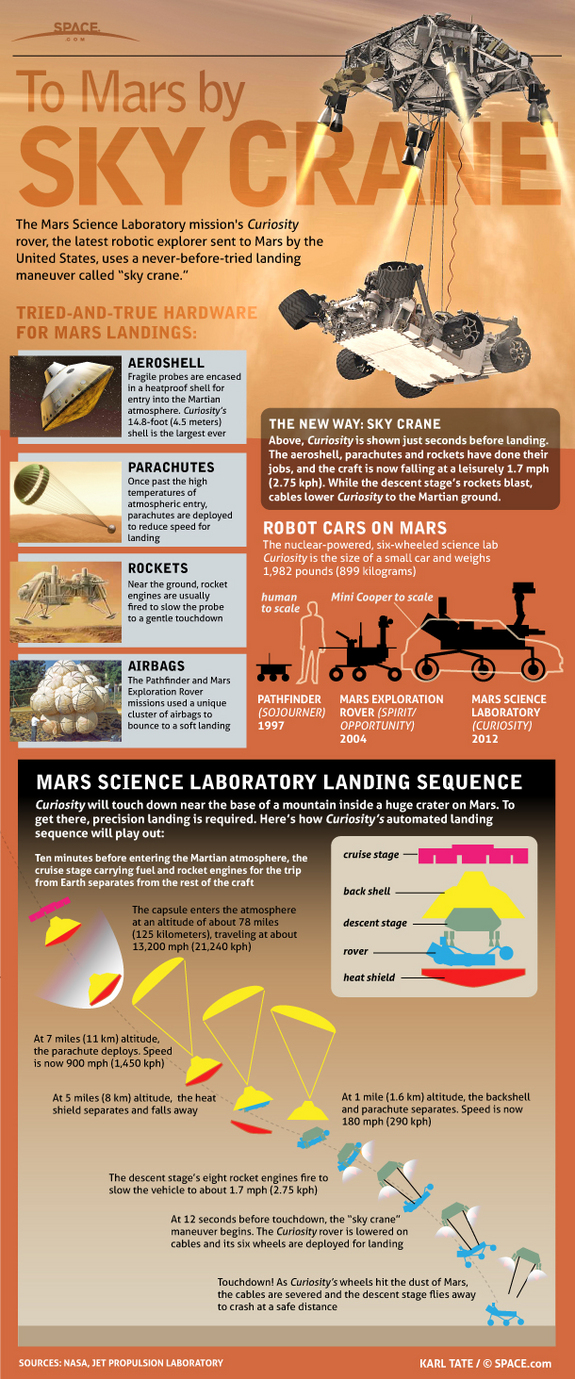
NASA launches super-size Mars rover to red planet


CAPE CANAVERAL, Fla. (AP) — The world's biggest extraterrestrial explorer, NASA's Curiosity rover, rocketed toward Mars on Saturday on a search for evidence that the red planet might once have been home to itsy-bitsy life.
It will take 8½ months for Curiosity to reach Mars following a journey of 354 million miles.
An unmanned Atlas V rocket hoisted the rover, officially known asMars Science Laboratory, into a cloudy late morning sky. A Mars frenzy gripped the launch site, with more than 13,000 guests jamming the space center for NASA's first launch to Earth's next-door neighbor in four years, and the first send-off of a Martian rover in eight years.
NASA astrobiologist Pan Conrad, whose carbon compound-seeking instrument is on the rover, had a shirt custom made for the occasion. Her bright blue, short-sleeve blouse was emblazoned with rockets, planets and the words, "Next stop Mars!"
Conrad jumped and cheered as the rocket blasted off a few miles away.
"It's amazing," she said, "and it's a huge relief to see it all going up in the same direction."
The 1-ton Curiosity — as large as a car — is a mobile, nuclear-powered laboratory holding 10 science instruments that will sample Martian soil and rocks, and analyze them right on the spot. There's a drill as well as a stone-zapping laser machine.
It's "really a rover on steroids," said NASA's Colleen Hartman, assistant associate administrator for science. "It's an order of magnitude more capable than anything we have ever launched to any planet in the solar system."
The primary goal of the $2.5 billion mission is to see whether cold, dry, barren Mars might have been hospitable for microbial life once upon a time — or might even still be conducive to life now. No actual life detectors are on board; rather, the instruments will hunt for organic compounds.
Curiosity's 7-foot arm has a jackhammer on the end to drill into the Martian red rock, and the 7-foot mast on the rover is topped with high-definition and laser cameras. No previous Martian rover has been so sophisticated or capable.
With Mars the ultimate goal for astronauts, NASA also will use Curiosity to measure radiation at the red planet. The rover also has a weather station on board that will provide temperature, wind and humidity readings; a computer software app with daily weather updates is planned.
The world has launched more than three dozen missions to the ever-alluring Mars, which is more like Earth than the other solar-system planets. Yet fewer than half those quests have succeeded.
Just two weeks ago, a Russian spacecraft ended up stuck in orbit around Earth, rather than en route to the Martian moon Phobos.
"Mars really is the Bermuda Triangle of the solar system," Hartman said. "It's the death planet, and the United States of America is the only nation in the world that has ever landed and driven robotic explorers on the surface of Mars, and now we're set to do it again."
Curiosity's arrival next August will be particularly hair-raising.
In a spacecraft first, the rover will be lowered onto the Martian surface via a jet pack and tether system similar to the sky cranes used to lower heavy equipment into remote areas on Earth.
Curiosity is too heavy to use air bags like its much smaller predecessors, Spirit and Opportunity, did in 2004. Besides, this new way should provide for a more accurate landing.
Astronauts will need to make similarly precise landings on Mars one day.
Curiosity will spend a minimum of two years roaming around Gale Crater, chosen as the landing site because it's rich in minerals. Scientists said if there is any place on Mars that might have been ripe for life, it would be there.
"I like to say it's extraterrestrial real estate appraisal," Conrad said with a chuckle earlier in the week.
The rover — 10 feet long and 9 feet wide — should be able to go farther and work harder than any previous Mars explorer because of its power source: 10.6 pounds of radioactive plutonium. The nuclear generator was encased in several protective layers in case of a launch accident.
NASA expects to put at least 12 miles on the odometer, once the rover sets down on the Martian surface.
This is the third astronomical mission to be launched from Cape Canaveral by NASA since the retirement of the venerable space shuttle fleet this summer. The Juno probe is en route to Jupiter, and twin spacecraft named Grail will arrive at Earth's moon on New Year's Eve and Day.
NASA hails this as the year of the solar system.
___
Online:
NASA: http://marsprogram.jpl.nasa.gov/msl/
<

Saturday, November 26, 2011

Inside Huge Mars Rover's Sky Crane Landing

Tuesday, November 22, 2011

Scientists create light from vacuum

Scientists create light from vacuum

In the Chalmers scientists’ experiments, virtual photons bounce off a “mirror” that vibrates at a speed that is almost as high as the speed of light. The round mirror in the picture is a symbol, and under that is the quantum electronic component (referred to as a SQUID), which acts as a mirror. This makes real photons appear (in pairs) in vacuum. Credit: Philip Krantz, Chalmers

(PhysOrg.com) -- Scientists at Chalmers University of Technology have succeeded in creating light from vacuum – observing an effect first predicted over 40 years ago. The results will be published tomorrow (Wednesday) in the journal Nature. In an innovative experiment, the scientists have managed to capture some of the photons that are constantly appearing and disappearing in the vacuum.

The experiment is based on one of the most counterintuitive, yet, one of the most important principles in 
 mechanics: that  is by no means empty nothingness. In fact, the vacuum is full of various particles that are continuously fluctuating in and out of existence. They appear, exist for a brief moment and then disappear again. Since their existence is so fleeting, they are usually referred to as virtual particles.
Chalmers scientist, Christopher Wilson and his co-workers have succeeded in getting  to leave their virtual state and become real photons, i.e. measurable light. The physicist Moore predicted way back in 1970 that this should happen if the virtual photons are allowed to bounce off a mirror that is moving at a speed that is almost as high as the speed of light. The phenomenon, known as the dynamical Casimir effect, has now been observed for the first time in a brilliant experiment conducted by the Chalmers scientists.
“Since it’s not possible to get a mirror to move fast enough, we’ve developed another method for achieving the same effect,” explains Per Delsing, Professor of Experimental Physics at Chalmers. “Instead of varying the physical distance to a mirror, we've varied the electrical distance to an electrical short circuit that acts as a mirror for microwaves.
The “mirror” consists of a quantum electronic component referred to as a SQUID (Superconducting quantum interference device), which is extremely sensitive to magnetic fields. By changing the direction of the magnetic field several billions of times a second the scientists were able to make the “mirror” vibrate at a speed of up to 25 percent of the speed of light.
“The result was that photons appeared in pairs from the vacuum, which we were able to measure in the form of microwave radiation,” says Per Delsing. “We were also able to establish that the radiation had precisely the same properties that quantum theory says it should have when photons appear in pairs in this way.”
What happens during the experiment is that the “” transfers some of its kinetic energy to virtual photons, which helps them to materialise. According to quantum mechanics, there are many different types of virtual particles in vacuum, as mentioned earlier. Göran Johansson, Associate Professor of Theoretical Physics, explains that the reason why photons appear in the experiment is that they lack mass.
“Relatively little energy is therefore required in order to excite them out of their virtual state. In principle, one could also create other particles from vacuum, such as electrons or protons, but that would require a lot more energy.”
The scientists find the photons that appear in pairs in the experiment interesting to study in closer detail. They can perhaps be of use in the research field of quantum information, which includes the development of quantum computers.
However, the main value of the experiment is that it increases our understanding of basic physical concepts, such as vacuum fluctuations – the constant appearance and disappearance of virtual particles in vacuum. It is believed that vacuum fluctuations may have a connection with “dark energy” which drives the accelerated expansion of the universe. The discovery of this acceleration was recognised this year with the awarding of the Nobel Prize in Physics.

Saturday, November 19, 2011

Galaxy on Edge


NOVEMBER 18, 2009: The magnificent galaxy NGC 4710 is tilted nearly edge-on to our view from Earth. This perspective allows astronomers to easily distinguish the central bulge of stars from its pancake-flat disk of stars, dust, and gas. What's striking in the image is a ghostly "X" pattern of stars. This natural-color photo was taken with the Hubble Space Telescope's Advanced Camera for Surveys on January 15, 2006.

For more information about galaxy NGC 4710 visit:
http://www.spacetelescope.org/news/html/heic0914.html .

Hubble's Deepest View of Universe Unveils Never-Before-Seen Galaxies


DECEMBER 8, 2009: NASA's Hubble Space Telescope has made the deepest image of the universe ever taken in near-infrared light. The faintest and reddest objects in the image are galaxies that formed 600 million years after the Big Bang. No galaxies have been seen before at such early times. The new deep view, taken in late August 2009, also provides insights into how galaxies grew in their formative years early in the universe's history. The image was taken in the same region as the Hubble Ultra Deep Field (HUDF), which was taken in 2004 and is the deepest visible-light image of the universe. Hubble's newly installed Wide Field Camera 3 (WFC3) collects light from near-infrared wavelengths and therefore looks even deeper into the universe, because the light from very distant galaxies is stretched out of the ultraviolet and visible regions of the spectrum into near-infrared wavelengths by the expansion of the universe.

Ambitious Hubble Survey Obtaining New Dark Matter Census


OCTOBER 13, 2011: Cluster MACS J1206.2-0847 (or MACS 1206 for short) is one of the first targets in a Hubble Space Telescope survey that will allow astronomers to construct the highly detailed dark matter maps of more galaxy clusters than ever before. These maps are being used to test previous but surprising results that suggest that dark matter is more densely packed inside galaxy clusters than some models predict. This might mean that galaxy cluster assembly began earlier than commonly thought. The multiwavelength survey, called the Cluster Lensing And Supernova survey with Hubble (CLASH), probes, with unparalleled precision, the distribution of dark matter in 25 massive clusters of galaxies. So far, the CLASH team has completed observations of six of the 25 clusters. MACS 1206 lies 4.5 billion light-years from Earth. This image was taken with Hubble's Advanced Camera for Surveys and the Wide Field Camera 3 in April 2011 through July 2011 <

Super Star Clusters in the Antennae Galaxies


This new NASA Hubble Space Telescope image of the Antennae galaxies is the sharpest yet of this merging pair of galaxies. During the course of the collision, billions of stars will be formed. The brightest and most compact of these star birth regions are called super star clusters.

The two spiral galaxies started to interact a few hundred million years ago, making the Antennae galaxies one of the nearest and youngest examples of a pair of colliding galaxies. Nearly half of the faint objects in the Antennae image are young clusters containing tens of thousands of stars. The orange blobs to the left and right of image center are the two cores of the original galaxies and consist mainly of old stars criss-crossed by filaments of dust, which appears brown in the image. The two galaxies are dotted with brilliant blue star-forming regions surrounded by glowing hydrogen gas, appearing in the image in pink.

The new image allows astronomers to better distinguish between the stars and super star clusters created in the collision of two spiral galaxies. By age dating the clusters in the image, astronomers find that only about 10 percent of the newly formed super star clusters in the Antennae will survive beyond the first 10 million years. The vast majority of the super star clusters formed during this interaction will disperse, with the individual stars becoming part of the smooth background of the galaxy. It is however believed that about a hundred of the most massive clusters will survive to form regular globular clusters, similar to the globular clusters found in our own Milky Way galaxy.

The Antennae galaxies take their name from the long antenna-like "arms" extending far out from the nuclei of the two galaxies, best seen by ground-based telescopes. These "tidal tails" were formed during the initial encounter of the galaxies some 200 to 300 million years ago. They give us a preview of what may happen when our Milky Way galaxy will collide with the neighboring Andromeda galaxy in several billion years.

For more information, please contact:

Ray Villard
Space Telescope Science Institute, Baltimore, Md.
(Phone: 410-338-4514; E-mail: villard@stsci.edu)

Lars Lindberg Christensen
Hubble/ESA, Garching, Germany
(Phone: 011-49-89-3200-6306; Cell: 011-49-173-3872-621; E-mail: lars@eso.org)

Brad Whitmore
Space Telescope Science Institute, Baltimore, Md.
(Phone: 410-338-4474; E-mail: whitmore@stsci.edu)

Object Names: NGC 4038/4039, Antennae Galaxy

Image Type: Astronomical

Credit: NASA, ESA, and the Hubble Heritage Team (STScI/AURA)-ESA/Hubble Collaboration

Acknowledgment: B. Whitmore (Space Telescope Science Institute)

Massive Black Holes in Galaxies NGC 3377, NGC 3379 and NGC 4486b


Announcing the discovery of three black holes in three normal galaxies, an international team of astronomers suggests nearly all galaxies may harbor supermassive black holes which once powered quasars (extremely luminous nuclei of galaxies), but are now quiescent.

This conclusion is based on a census of 27 nearby galaxies carried out by NASA's Hubble Space Telescope and ground-based telescopes in Hawaii, which are being used to conduct a spectroscopic and photometric survey of galaxies to find black holes which have consumed the mass of millions of Sun-like stars.

The findings, being presented today at the 189th Meeting of the American Astronomical Society in Toronto, Canada, should provide insights into the origin and evolution of galaxies, as well as clarify the role of quasars in galaxy evolution.

The key results are:

Supermassive black holes are so common, nearly every large galaxy has one.

A black hole's mass is proportional to the mass of the host galaxy, so that, for example, a galaxy twice as massive as another would have a black hole that is also twice as massive. This discovery suggests that the growth of the black hole is linked to the formation of the galaxy in which it is located.

The number and masses of the black holes found are consistent with what would have been required to power the quasars.
"We believe we are looking at "fossil quasars" and that most galaxies at one time burned brightly as a quasar," says team leader Doug Richstone of the University of Michigan, Ann Arbor, Michigan. These conclusions are consistent with previous Hubble Space Telescope observations showing quasars dwelling in a variety of galaxies, from isolated normal-looking galaxies to colliding pairs.

Two of the black holes "weigh in" at 50 million and 100 million solar masses in the cores of galaxies NGC 3379 (also known as M105) and NGC 3377 respectively. These galaxies are in the "Leo Spur", a nearby group of galaxies about 32 million light-years away and roughly in the direction of the Virgo cluster.

Located 50 million light-years away in the Virgo cluster, NGC 4486B possesses a 500-million solar mass black hole. It is a small satellite of the galaxy M87, a very bright galaxy in the Virgo cluster. M87 has an active nucleus and is known to have a black hole of about 2 billion solar masses.

Though several groups have previously found massive black holes dwelling in galaxies the size of our Milky Way or larger, these new results suggest smaller galaxies have lower-mass black holes, below Hubble's detection limit. The survey shows the black hole's mass is proportional to the host galaxy's mass. Like shoe sizes on adults, the bigger the galaxy, the larger the black hole.

It remains a challenging puzzle as to why black holes are so abundant, or why they should be proportional to a galaxy's mass. One idea, supported by previous Hubble observations, is that galaxies formed out of smaller "building blocks" consisting of star clusters. A massive "seed" black hole may have been present in each of these protogalaxies. The larger number of building blocks needed to merge and form very luminous galaxies would naturally have provided more seed black holes to coalesce into a single, massive black hole residing in a galaxy's nucleus.

An alternative model is that galaxies start at some early epoch with a modest black hole (not necessarily approaching the masses discussed here), but that the black hole consumes some fixed fraction of the total gas shed by the stars in the galaxy during their normal evolution. If that fraction is around 1 percent, the black holes could easily weigh as much as they do now, and would naturally track the current luminosity of the galaxy.

Critical ground-based observations to identify candidates were obtained for all three of these objects by John Kormendy with the Canada-France-Hawaii Telescope (CFHT) on Mauna Kea, Hawaii. The NGC 4486b black hole detection was also based on CFHT spectra.

Hubble's high resolution then allowed the team to peer deep into the cores of the galaxies with extraordinary resolution unavailable from ground-based telescopes, and measure velocities of stars orbiting the black hole. A sharp rise in velocity means that a great deal of matter is locked away in the galaxy's core, creating a powerful gravitational field that accelerates nearby stars.

The team is confident their statistical search technique has allowed them to pinpoint all the black holes they expect to see, above a certain mass limit. "However, our result is complicated by the fact that the observational data for the galaxies are not of equal quality, and that the galaxies are at different distances," says Richstone.

One of the features of the February 1997 servicing mission to the Hubble will be the installation of the Space Telescope Imaging Spectrograph (STIS). This spectrograph will greatly increase the efficiency of projects, such as this black hole census, that require spectra of several nearby positions in a single object. This group will be continuing this census with the refurbished telescope.

The team members are Douglas Richstone (team leader), Karl Gebhardt (University of Michigan), Scott Tremaine and John Magorrian (University of Toronto, Canadian Institute for Advanced Research), John Kormendy (University of Hawaii), Tod Lauer (National Optical Astronomy Observatories), Alan Dressler (Carnegie Observatories), Sandra Faber (University of California), Ralf Bender (Ludwig Maximilian University, Munich), Ed Ajhar (National Optical Astronomy Observatories), and Carl Grillmair (Jet Propulsion Laboratory).

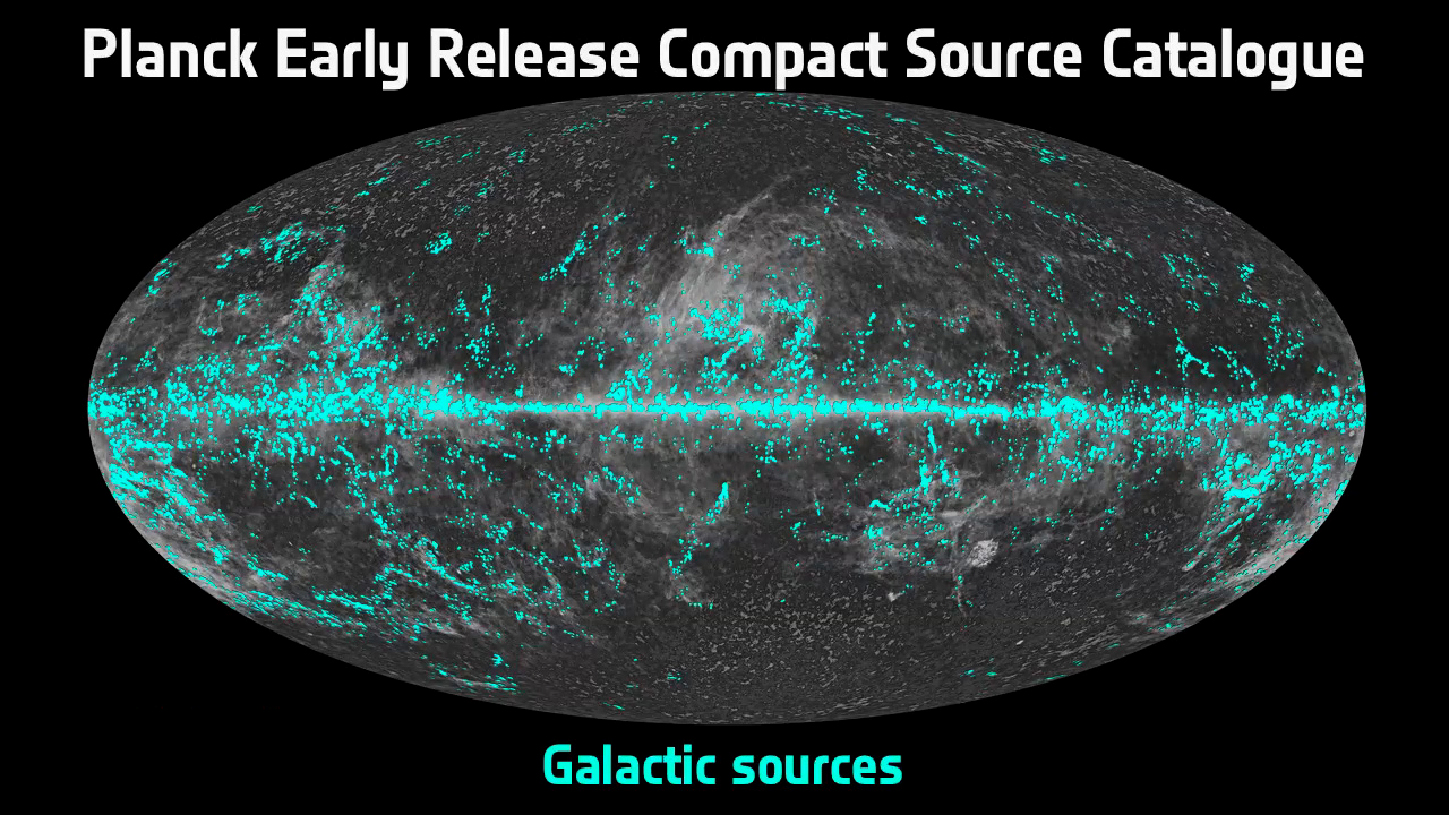
All-sky distribution of galactic sources in the ERCSC


Date: 11 Jan 2011
Satellite: Planck
Depicts: All-sky distribution of galactic sources in the ERCSC
Copyright: ESA/Planck Collaboration
This image illustrates the position on the sky of all galactic sources detected by Planck during its first all-sky survey and listed in the Early Release Compact Source Catalogue (ERCSC).
This sample of compact sources includes features in the galactic interstellar medium, cold molecular cloud cores, and stars with dust shells. In particular, a dedicated resource, the Early Cold Cores Catalogue, comprising 915 molecular cloud cores with temperature cooler than 14 Kelvin, has been made publicly available along with the ERCSC.
The size of the spots displayed in the image reflects the brightness of the sources.

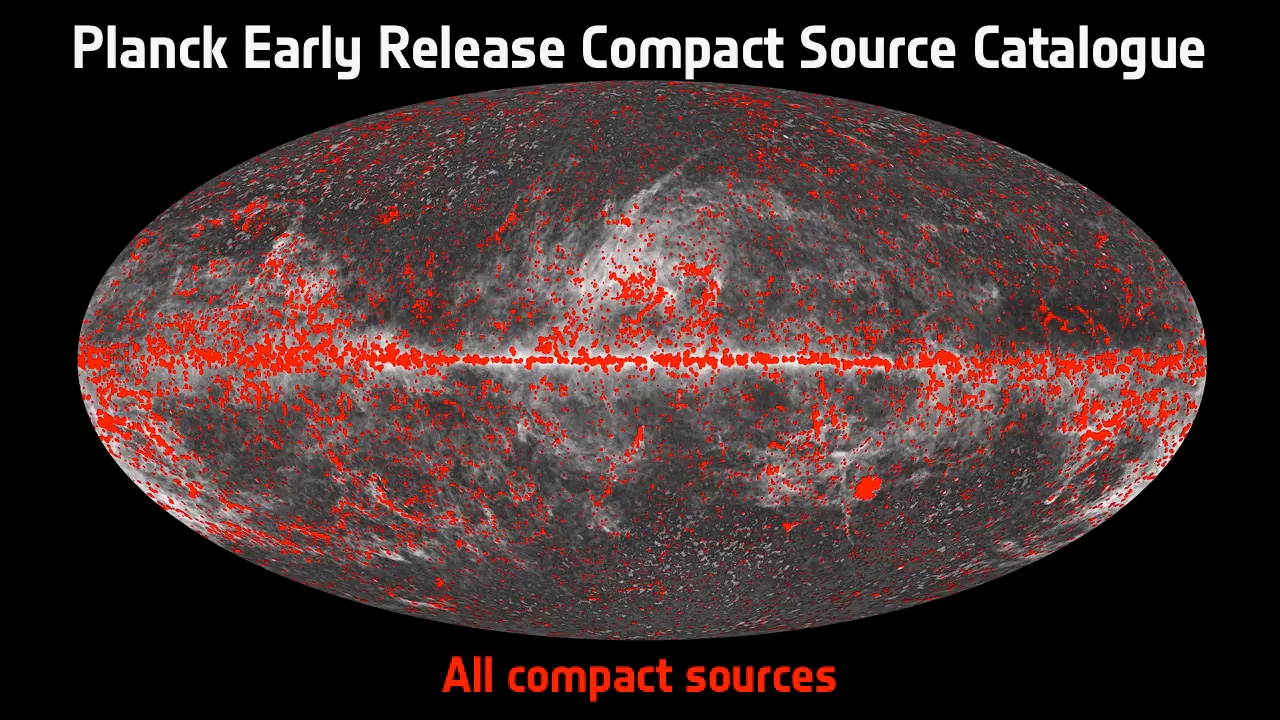
All-sky distribution of all compact sources in the ERCSC


Date: 11 Jan 2011
Satellite: Planck
Depicts: Compact Sources
Copyright: ESA/Planck Collaboration
This image illustrates the position on the sky of all compact sources detected by Planck during its first all-sky survey and listed in the Early Release Compact Source Catalogue (ERCSC).
The ERCSC contains more than 15,000 unique compact sources. These sources have been extracted from the individual lists of sources detected at each of the frequencies probed by Planck by applying a specific set of criteria which identify single sources from sources in the individual lists which are at the same location and at adjacent frequencies.
The size of the spots displayed in the image reflects the brightness of the sources.
The ERCSC comprises a wide variety of astronomical objects, both galactic (features in the galactic interstellar medium, cold molecular cloud cores, stars with dust shells) and extragalactic (radio galaxies, blazars, infrared-luminous galaxies, and galaxy clusters), and it represents a rich and robust database for the entire astronomical community.

Friday, November 18, 2011

Danger! Falling Rocks: Meteorites and Asteroids

Is the New Physics Here? Atom Smashers Get an Antimatter Surprise


By lt | LiveScience.com 
The world's largest atom smasher, designed as a portal to a new view of physics, has produced its first peek at the unexpected: bits of matter that don't mirror the behavior of their antimatter counterparts.
The discovery, if confirmed, could rewrite the known laws ofparticle physics and help explain why our universe is made mostly of matter and not antimatter.
Scientists at the Large Hadron Collider, the 17-mile (27 km) circular particle accelerator underground near Geneva, Switzerland, have been colliding protons at high speeds to create explosions of energy. From this energy many subatomic particles are produced.
Now researchers at the accelerator's LHCb experiment are reporting that some matter particles produced inside the machine appear to be behaving differently from their antimatter counterparts, which might provide a partial explanation to the mystery of antimatter. [The Coolest Little Particles in Nature]
Missing antimatter
Scientists think the universe started off with roughly equal amounts of matter and antimatter. (Particles of antimatter have the same mass of their twins but an opposite charge.) Somehow over the ensuing 14 billion years, most of the antimatter was destroyed, leaving a leftover universe of mainly matter.
One potential explanation for this outcome is called "charge-parity violation."  CP violation means that particles of opposite charge behave differently from one another.
The LHCb researchers found preliminary evidence that this is happening when particles called D-mesons, which contain "charmed quarks," decay into other particles. The whimsically named charmed quarks, like many exotic particles, are so unstable, they last only a fraction of a second. They quickly decay into other particles, and it is these products that the experiment detects. ("LHCb" is short for LHC-beauty, another flavor of quark.)
From the experiment, the researchers found a 0.8 percent difference in the probabilities that the matter and antimatter versions of these particles would decay into a particular end state.
Ruling out a fluke
When it comes to particle physics, it's all about the quality of statistics. Measuring something once is meaningless because of the high degree of uncertainty involved in such exotic, small systems. Scientists rely on taking measurements over and over again — enough times to dismiss the chance of a fluke.
The new finding ranks as a "3.5 sigma" result, meaning the statistics are solid enough that there is only a 0.05 percent likelihood that the pattern they see isn't really there. For something to count as a true discovery in particle physics, it must reach a 5 sigma level of confidence.
"It's certainly exciting, and certainly worth pursuing," LHCb researcher Matthew Charles of England's Oxford University told LiveScience. "At this point it's a tantalizing hint. It's evidence of something interesting going on, but we're keeping the champagne on ice, let's say."
By the end of 2012, Charles said, the Large Hadron Collider should have collected enough data to either confirm or reject the result.
LHC's birthright
If the finding is borne out, it would be a big deal, because it would mean the reigning theory of particle physics, called the Standard Model, is incomplete. Currently the Standard Model does allow for some minor CP violation, but not at the level of 0.8 percent. To explain these results, scientists would have to alter their theory or add some new physics to the existing picture.
In either case, the LHC would have begun to claim its birthright.
"The whole driving purpose of the LHC is to discover and understand new physics beyond the Standard Model," Charles said. "This sort of analysis is exactly why I joined LHCb."
One possible example of the kind of new physics that might explain such CP violation is called supersymmetry. This theory suggests that in addition to all the known particles, there aresupersymmetric partner particles that differ by half a unit of spin. Spin is one of the fundamental characteristics of elementary particles.
So far, no one has found direct evidence of supersymmetry. But if supersymmetric particles exist, they might be created instantaneously and disappear again during the particle-decay process. That way they could interfere with the decay process, potentially explaining why matter and antimatter decay differently.
Charles reported the LHCb team's findings this week in Paris at the Hadron Collider Physics Symposium.