Image Of The day

See the newest image from scientist ultra advanced device

Planck Image Of The Early Universe

The color-coded image is effectively a photograph of the universe when it was only 379 000 y old,which was about 13.7 billion years ago. An amazing picture from the universe

Two colliding galaxies

The colliding galaxies NGC 4676 leave a trail of stars, this image was taken by Hubble Space Telescope

Earth seen from Appllo Moon landing mision

Space Exploration in the middle 20th century increasing human knowledge to new era science

CERN Large Hadron Collider tunnel

Huge particle smasher, like LHC is a gigantic and complex engineering marvel that disigned to detect particles at extreme energies

Hubble Space telescope seen from last service

Multi billion dollar device like HST can brings very deep image from the heart of the universe

Saturday, November 19, 2011

Galaxy on Edge


NOVEMBER 18, 2009: The magnificent galaxy NGC 4710 is tilted nearly edge-on to our view from Earth. This perspective allows astronomers to easily distinguish the central bulge of stars from its pancake-flat disk of stars, dust, and gas. What's striking in the image is a ghostly "X" pattern of stars. This natural-color photo was taken with the Hubble Space Telescope's Advanced Camera for Surveys on January 15, 2006.

For more information about galaxy NGC 4710 visit:
http://www.spacetelescope.org/news/html/heic0914.html .

Hubble's Deepest View of Universe Unveils Never-Before-Seen Galaxies


DECEMBER 8, 2009: NASA's Hubble Space Telescope has made the deepest image of the universe ever taken in near-infrared light. The faintest and reddest objects in the image are galaxies that formed 600 million years after the Big Bang. No galaxies have been seen before at such early times. The new deep view, taken in late August 2009, also provides insights into how galaxies grew in their formative years early in the universe's history. The image was taken in the same region as the Hubble Ultra Deep Field (HUDF), which was taken in 2004 and is the deepest visible-light image of the universe. Hubble's newly installed Wide Field Camera 3 (WFC3) collects light from near-infrared wavelengths and therefore looks even deeper into the universe, because the light from very distant galaxies is stretched out of the ultraviolet and visible regions of the spectrum into near-infrared wavelengths by the expansion of the universe.

Ambitious Hubble Survey Obtaining New Dark Matter Census


OCTOBER 13, 2011: Cluster MACS J1206.2-0847 (or MACS 1206 for short) is one of the first targets in a Hubble Space Telescope survey that will allow astronomers to construct the highly detailed dark matter maps of more galaxy clusters than ever before. These maps are being used to test previous but surprising results that suggest that dark matter is more densely packed inside galaxy clusters than some models predict. This might mean that galaxy cluster assembly began earlier than commonly thought. The multiwavelength survey, called the Cluster Lensing And Supernova survey with Hubble (CLASH), probes, with unparalleled precision, the distribution of dark matter in 25 massive clusters of galaxies. So far, the CLASH team has completed observations of six of the 25 clusters. MACS 1206 lies 4.5 billion light-years from Earth. This image was taken with Hubble's Advanced Camera for Surveys and the Wide Field Camera 3 in April 2011 through July 2011 <

Super Star Clusters in the Antennae Galaxies


This new NASA Hubble Space Telescope image of the Antennae galaxies is the sharpest yet of this merging pair of galaxies. During the course of the collision, billions of stars will be formed. The brightest and most compact of these star birth regions are called super star clusters.

The two spiral galaxies started to interact a few hundred million years ago, making the Antennae galaxies one of the nearest and youngest examples of a pair of colliding galaxies. Nearly half of the faint objects in the Antennae image are young clusters containing tens of thousands of stars. The orange blobs to the left and right of image center are the two cores of the original galaxies and consist mainly of old stars criss-crossed by filaments of dust, which appears brown in the image. The two galaxies are dotted with brilliant blue star-forming regions surrounded by glowing hydrogen gas, appearing in the image in pink.

The new image allows astronomers to better distinguish between the stars and super star clusters created in the collision of two spiral galaxies. By age dating the clusters in the image, astronomers find that only about 10 percent of the newly formed super star clusters in the Antennae will survive beyond the first 10 million years. The vast majority of the super star clusters formed during this interaction will disperse, with the individual stars becoming part of the smooth background of the galaxy. It is however believed that about a hundred of the most massive clusters will survive to form regular globular clusters, similar to the globular clusters found in our own Milky Way galaxy.

The Antennae galaxies take their name from the long antenna-like "arms" extending far out from the nuclei of the two galaxies, best seen by ground-based telescopes. These "tidal tails" were formed during the initial encounter of the galaxies some 200 to 300 million years ago. They give us a preview of what may happen when our Milky Way galaxy will collide with the neighboring Andromeda galaxy in several billion years.

For more information, please contact:

Ray Villard
Space Telescope Science Institute, Baltimore, Md.
(Phone: 410-338-4514; E-mail: villard@stsci.edu)

Lars Lindberg Christensen
Hubble/ESA, Garching, Germany
(Phone: 011-49-89-3200-6306; Cell: 011-49-173-3872-621; E-mail: lars@eso.org)

Brad Whitmore
Space Telescope Science Institute, Baltimore, Md.
(Phone: 410-338-4474; E-mail: whitmore@stsci.edu)

Object Names: NGC 4038/4039, Antennae Galaxy

Image Type: Astronomical

Credit: NASA, ESA, and the Hubble Heritage Team (STScI/AURA)-ESA/Hubble Collaboration

Acknowledgment: B. Whitmore (Space Telescope Science Institute)

Massive Black Holes in Galaxies NGC 3377, NGC 3379 and NGC 4486b


Announcing the discovery of three black holes in three normal galaxies, an international team of astronomers suggests nearly all galaxies may harbor supermassive black holes which once powered quasars (extremely luminous nuclei of galaxies), but are now quiescent.

This conclusion is based on a census of 27 nearby galaxies carried out by NASA's Hubble Space Telescope and ground-based telescopes in Hawaii, which are being used to conduct a spectroscopic and photometric survey of galaxies to find black holes which have consumed the mass of millions of Sun-like stars.

The findings, being presented today at the 189th Meeting of the American Astronomical Society in Toronto, Canada, should provide insights into the origin and evolution of galaxies, as well as clarify the role of quasars in galaxy evolution.

The key results are:

Supermassive black holes are so common, nearly every large galaxy has one.

A black hole's mass is proportional to the mass of the host galaxy, so that, for example, a galaxy twice as massive as another would have a black hole that is also twice as massive. This discovery suggests that the growth of the black hole is linked to the formation of the galaxy in which it is located.

The number and masses of the black holes found are consistent with what would have been required to power the quasars.
"We believe we are looking at "fossil quasars" and that most galaxies at one time burned brightly as a quasar," says team leader Doug Richstone of the University of Michigan, Ann Arbor, Michigan. These conclusions are consistent with previous Hubble Space Telescope observations showing quasars dwelling in a variety of galaxies, from isolated normal-looking galaxies to colliding pairs.

Two of the black holes "weigh in" at 50 million and 100 million solar masses in the cores of galaxies NGC 3379 (also known as M105) and NGC 3377 respectively. These galaxies are in the "Leo Spur", a nearby group of galaxies about 32 million light-years away and roughly in the direction of the Virgo cluster.

Located 50 million light-years away in the Virgo cluster, NGC 4486B possesses a 500-million solar mass black hole. It is a small satellite of the galaxy M87, a very bright galaxy in the Virgo cluster. M87 has an active nucleus and is known to have a black hole of about 2 billion solar masses.

Though several groups have previously found massive black holes dwelling in galaxies the size of our Milky Way or larger, these new results suggest smaller galaxies have lower-mass black holes, below Hubble's detection limit. The survey shows the black hole's mass is proportional to the host galaxy's mass. Like shoe sizes on adults, the bigger the galaxy, the larger the black hole.

It remains a challenging puzzle as to why black holes are so abundant, or why they should be proportional to a galaxy's mass. One idea, supported by previous Hubble observations, is that galaxies formed out of smaller "building blocks" consisting of star clusters. A massive "seed" black hole may have been present in each of these protogalaxies. The larger number of building blocks needed to merge and form very luminous galaxies would naturally have provided more seed black holes to coalesce into a single, massive black hole residing in a galaxy's nucleus.

An alternative model is that galaxies start at some early epoch with a modest black hole (not necessarily approaching the masses discussed here), but that the black hole consumes some fixed fraction of the total gas shed by the stars in the galaxy during their normal evolution. If that fraction is around 1 percent, the black holes could easily weigh as much as they do now, and would naturally track the current luminosity of the galaxy.

Critical ground-based observations to identify candidates were obtained for all three of these objects by John Kormendy with the Canada-France-Hawaii Telescope (CFHT) on Mauna Kea, Hawaii. The NGC 4486b black hole detection was also based on CFHT spectra.

Hubble's high resolution then allowed the team to peer deep into the cores of the galaxies with extraordinary resolution unavailable from ground-based telescopes, and measure velocities of stars orbiting the black hole. A sharp rise in velocity means that a great deal of matter is locked away in the galaxy's core, creating a powerful gravitational field that accelerates nearby stars.

The team is confident their statistical search technique has allowed them to pinpoint all the black holes they expect to see, above a certain mass limit. "However, our result is complicated by the fact that the observational data for the galaxies are not of equal quality, and that the galaxies are at different distances," says Richstone.

One of the features of the February 1997 servicing mission to the Hubble will be the installation of the Space Telescope Imaging Spectrograph (STIS). This spectrograph will greatly increase the efficiency of projects, such as this black hole census, that require spectra of several nearby positions in a single object. This group will be continuing this census with the refurbished telescope.

The team members are Douglas Richstone (team leader), Karl Gebhardt (University of Michigan), Scott Tremaine and John Magorrian (University of Toronto, Canadian Institute for Advanced Research), John Kormendy (University of Hawaii), Tod Lauer (National Optical Astronomy Observatories), Alan Dressler (Carnegie Observatories), Sandra Faber (University of California), Ralf Bender (Ludwig Maximilian University, Munich), Ed Ajhar (National Optical Astronomy Observatories), and Carl Grillmair (Jet Propulsion Laboratory).

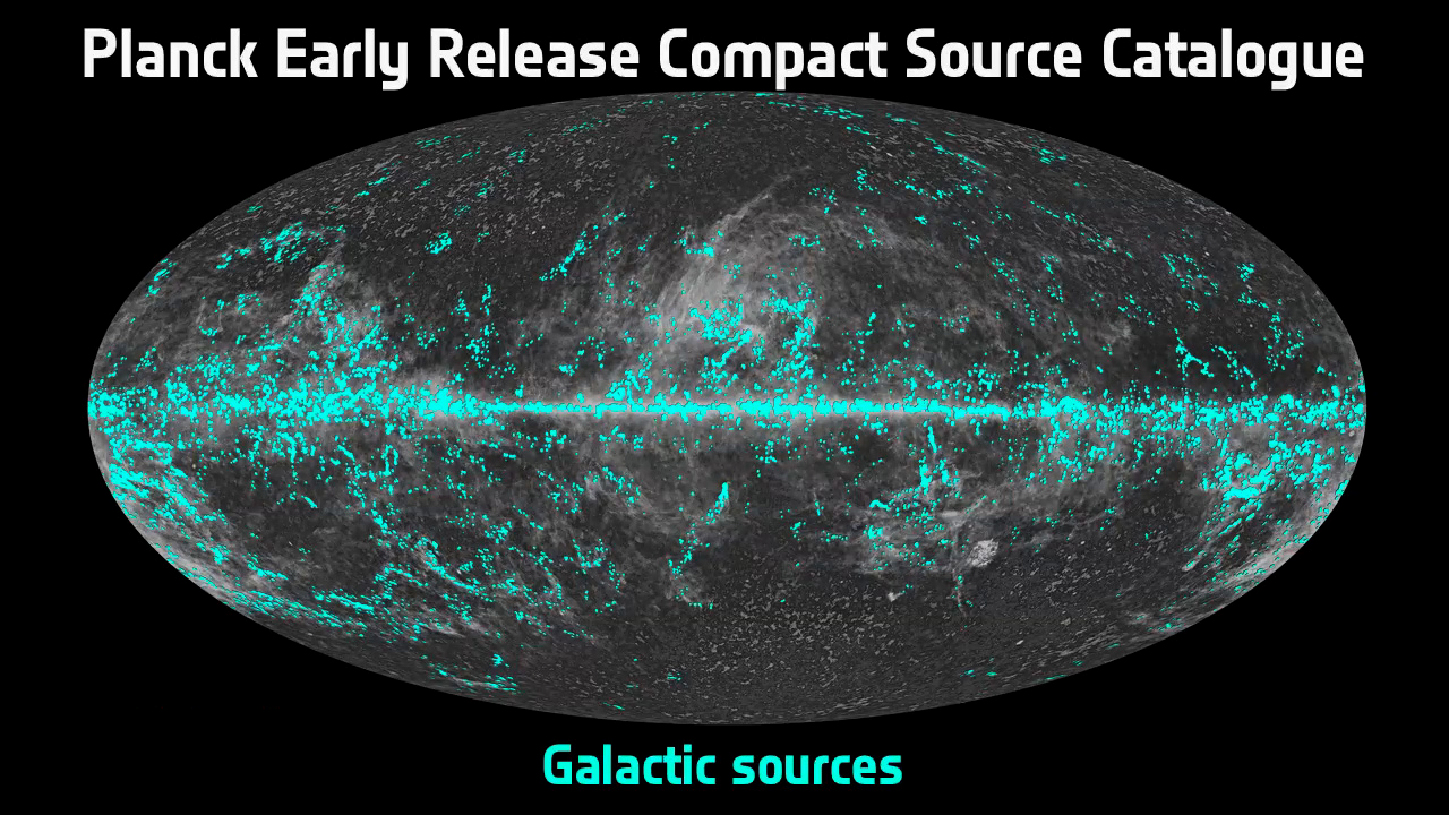
All-sky distribution of galactic sources in the ERCSC


Date: 11 Jan 2011
Satellite: Planck
Depicts: All-sky distribution of galactic sources in the ERCSC
Copyright: ESA/Planck Collaboration
This image illustrates the position on the sky of all galactic sources detected by Planck during its first all-sky survey and listed in the Early Release Compact Source Catalogue (ERCSC).
This sample of compact sources includes features in the galactic interstellar medium, cold molecular cloud cores, and stars with dust shells. In particular, a dedicated resource, the Early Cold Cores Catalogue, comprising 915 molecular cloud cores with temperature cooler than 14 Kelvin, has been made publicly available along with the ERCSC.
The size of the spots displayed in the image reflects the brightness of the sources.

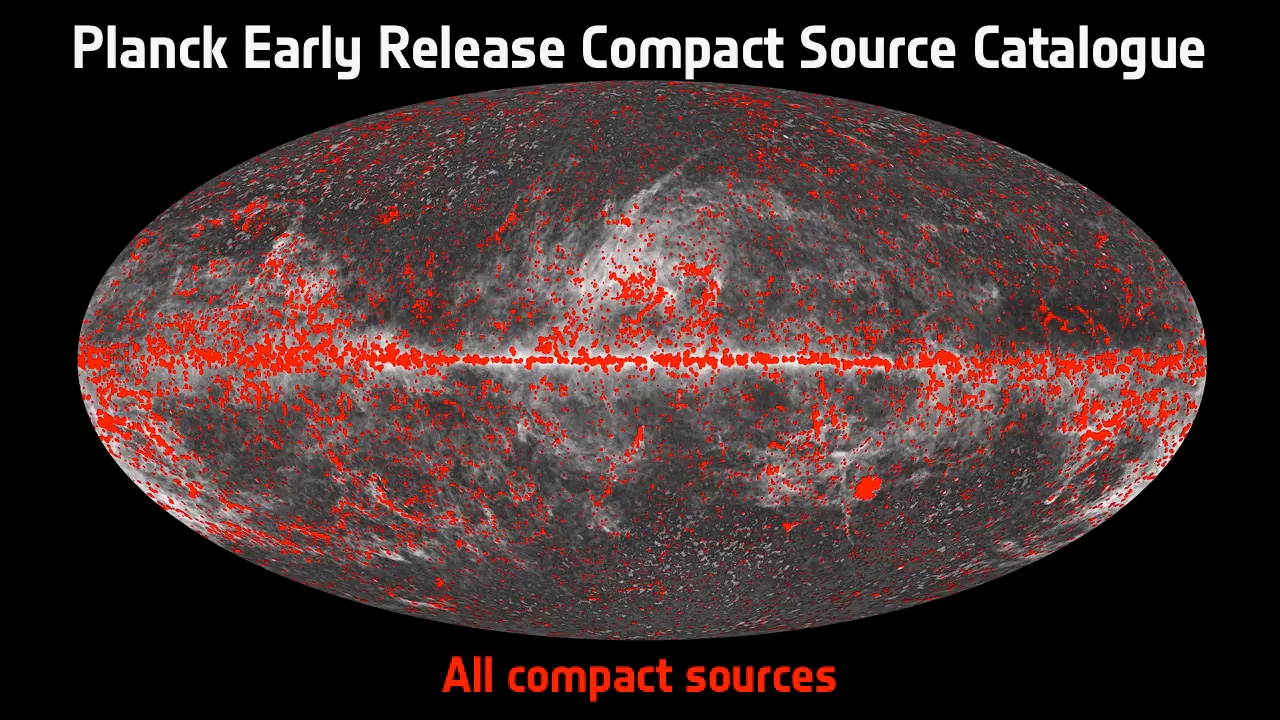
All-sky distribution of all compact sources in the ERCSC


Date: 11 Jan 2011
Satellite: Planck
Depicts: Compact Sources
Copyright: ESA/Planck Collaboration
This image illustrates the position on the sky of all compact sources detected by Planck during its first all-sky survey and listed in the Early Release Compact Source Catalogue (ERCSC).
The ERCSC contains more than 15,000 unique compact sources. These sources have been extracted from the individual lists of sources detected at each of the frequencies probed by Planck by applying a specific set of criteria which identify single sources from sources in the individual lists which are at the same location and at adjacent frequencies.
The size of the spots displayed in the image reflects the brightness of the sources.
The ERCSC comprises a wide variety of astronomical objects, both galactic (features in the galactic interstellar medium, cold molecular cloud cores, stars with dust shells) and extragalactic (radio galaxies, blazars, infrared-luminous galaxies, and galaxy clusters), and it represents a rich and robust database for the entire astronomical community.