Image Of The day

See the newest image from scientist ultra advanced device

Planck Image Of The Early Universe

The color-coded image is effectively a photograph of the universe when it was only 379 000 y old,which was about 13.7 billion years ago. An amazing picture from the universe

Two colliding galaxies

The colliding galaxies NGC 4676 leave a trail of stars, this image was taken by Hubble Space Telescope

Earth seen from Appllo Moon landing mision

Space Exploration in the middle 20th century increasing human knowledge to new era science

CERN Large Hadron Collider tunnel

Huge particle smasher, like LHC is a gigantic and complex engineering marvel that disigned to detect particles at extreme energies

Hubble Space telescope seen from last service

Multi billion dollar device like HST can brings very deep image from the heart of the universe

Monday, November 28, 2011

Solar Eclipse Wows Lucky Skywatchers in New Zealand

By SPACE.com Staff
Space.com | SPACE.com – 6 hrs ago
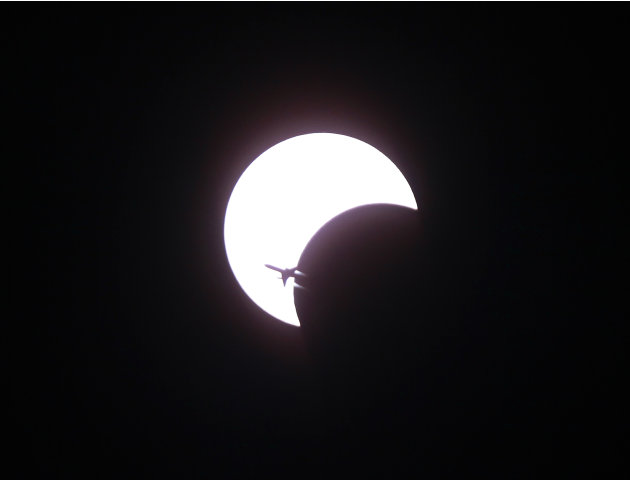

As consumers in the United States hunted for bargains last Friday (Nov. 25) on one of the busiest shopping days of the year, a few lucky skywatchers in New Zealand were treated to a very different kind of "Black Friday" — a partial solar eclipse that darkened the sky over parts of the southern hemisphere.
Last Friday, the moon passed between Earth and the sun, creating a partial solar eclipse for the fourth and final time this year.
The eclipse was only visible from certain locations in the southern hemisphere, including pockets of southern South Africa, across the Antarctic continent, Tasmania and parts of New Zealand. At greatest eclipse, the moon covered 90.5 percent of the sun's diameter from the point closest to the axis of Earth's shadow, which is a location in the Bellingshausen Sea on the west side of the Antarctic Peninsula, according to NASA scientists.
So, while majority of the planet could not see this partial solar eclipse, a few fortunate skywatchers in New Zealand captured some amazing photos of the event. [See photos of the partial solar eclipse]
Mike Nicholson and his wife, Terre Maize-Nicholson, saw the eclipse from Otaki Beach in New Zealand. While hazy conditions and strong winds threatened to spoil the show, they were able to snap some breath-taking images of the concealed sun.
"We left home about 30 [minutes] before the eclipse started, drove to [the] beach, and had to hide in the car as the weather was pretty vile," Nicholson told SPACE.com in an email. "At the time conditions were also extremely hazy; the sun was just a big white blob above the horizon. However as it descended toward the horizon and into the low cloud, conditions improved visually."
Observer James Tse caught a glimpse of the solar eclipsefrom Christchurch, New Zealand. As the sun was blackened by the moon, it "was distorted like a lady shoe during the mid-eclipse," Tse told SPACE.com in an email.
Nicholson and Tse shared some of their solar-eclipse photos on the website Spaceweather.com.
Solar eclipses are some of nature's most dramatic celestial events, and occur when the Earth, moon and sun are aligned on the same plane. Partial solar eclipses happen when the moon partly covers the sun as it travels between our planet and its closest star.
The eclipse Nov. 25 was the fourth and final one of the year. Partial solar eclipses previously occurred on Jan. 4, June 1 and July 1.
The next solar eclipse will occur May 20, 2012, and is expected to be a stunning event. The eclipse will be visible from China, Japan and parts of the United States, according to NASA scientists. During this so-called annular solar eclipse, the moon will cover a large portion (but not all) of the sun.
Sunday, November 27, 2011

NASA launches super-size Mars rover to red planet


CAPE CANAVERAL, Fla. (AP) — The world's biggest extraterrestrial explorer, NASA's Curiosity rover, rocketed toward Mars on Saturday on a search for evidence that the red planet might once have been home to itsy-bitsy life.
It will take 8½ months for Curiosity to reach Mars following a journey of 354 million miles.
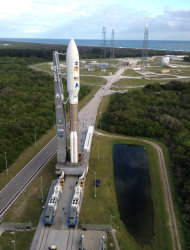
An unmanned Atlas V rocket hoisted the rover, officially known asMars Science Laboratory, into a cloudy late morning sky. A Mars frenzy gripped the launch site, with more than 13,000 guests jamming the space center for NASA's first launch to Earth's next-door neighbor in four years, and the first send-off of a Martian rover in eight years.
NASA astrobiologist Pan Conrad, whose carbon compound-seeking instrument is on the rover, had a shirt custom made for the occasion. Her bright blue, short-sleeve blouse was emblazoned with rockets, planets and the words, "Next stop Mars!"
Conrad jumped and cheered as the rocket blasted off a few miles away.
"It's amazing," she said, "and it's a huge relief to see it all going up in the same direction."
The 1-ton Curiosity — as large as a car — is a mobile, nuclear-powered laboratory holding 10 science instruments that will sample Martian soil and rocks, and analyze them right on the spot. There's a drill as well as a stone-zapping laser machine.
It's "really a rover on steroids," said NASA's Colleen Hartman, assistant associate administrator for science. "It's an order of magnitude more capable than anything we have ever launched to any planet in the solar system."
The primary goal of the $2.5 billion mission is to see whether cold, dry, barren Mars might have been hospitable for microbial life once upon a time — or might even still be conducive to life now. No actual life detectors are on board; rather, the instruments will hunt for organic compounds.
Curiosity's 7-foot arm has a jackhammer on the end to drill into the Martian red rock, and the 7-foot mast on the rover is topped with high-definition and laser cameras. No previous Martian rover has been so sophisticated or capable.
With Mars the ultimate goal for astronauts, NASA also will use Curiosity to measure radiation at the red planet. The rover also has a weather station on board that will provide temperature, wind and humidity readings; a computer software app with daily weather updates is planned.
The world has launched more than three dozen missions to the ever-alluring Mars, which is more like Earth than the other solar-system planets. Yet fewer than half those quests have succeeded.
Just two weeks ago, a Russian spacecraft ended up stuck in orbit around Earth, rather than en route to the Martian moon Phobos.
"Mars really is the Bermuda Triangle of the solar system," Hartman said. "It's the death planet, and the United States of America is the only nation in the world that has ever landed and driven robotic explorers on the surface of Mars, and now we're set to do it again."
Curiosity's arrival next August will be particularly hair-raising.
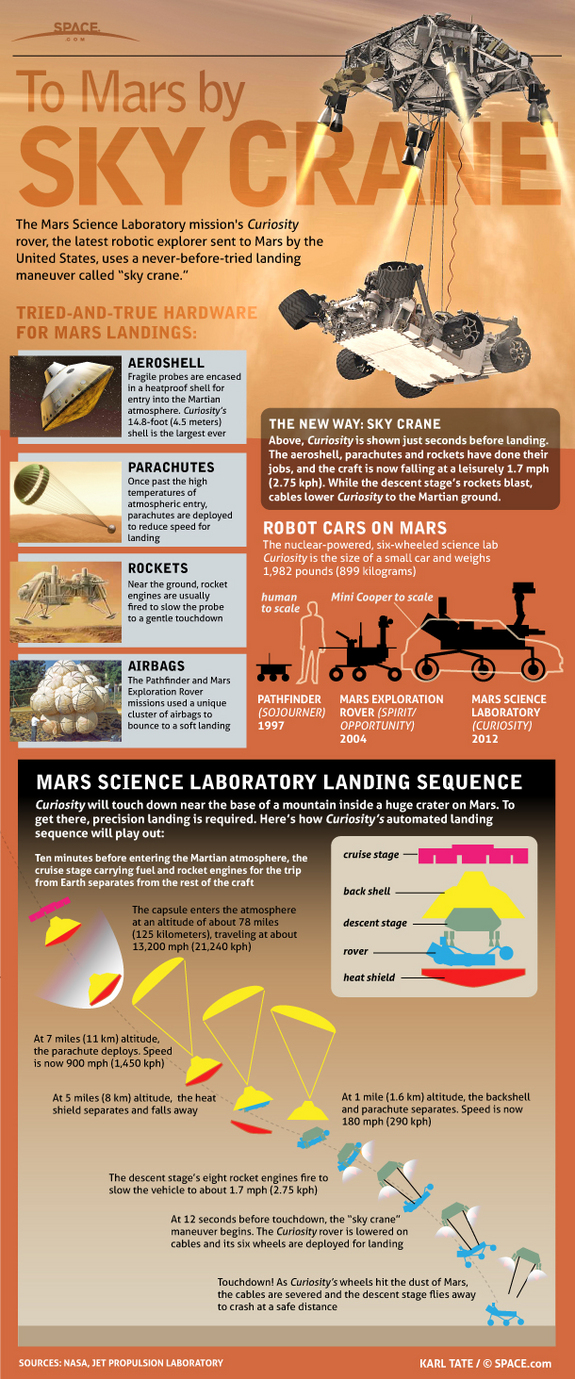
In a spacecraft first, the rover will be lowered onto the Martian surface via a jet pack and tether system similar to the sky cranes used to lower heavy equipment into remote areas on Earth.
Curiosity is too heavy to use air bags like its much smaller predecessors, Spirit and Opportunity, did in 2004. Besides, this new way should provide for a more accurate landing.
Astronauts will need to make similarly precise landings on Mars one day.
Curiosity will spend a minimum of two years roaming around Gale Crater, chosen as the landing site because it's rich in minerals. Scientists said if there is any place on Mars that might have been ripe for life, it would be there.
"I like to say it's extraterrestrial real estate appraisal," Conrad said with a chuckle earlier in the week.
The rover — 10 feet long and 9 feet wide — should be able to go farther and work harder than any previous Mars explorer because of its power source: 10.6 pounds of radioactive plutonium. The nuclear generator was encased in several protective layers in case of a launch accident.
NASA expects to put at least 12 miles on the odometer, once the rover sets down on the Martian surface.
This is the third astronomical mission to be launched from Cape Canaveral by NASA since the retirement of the venerable space shuttle fleet this summer. The Juno probe is en route to Jupiter, and twin spacecraft named Grail will arrive at Earth's moon on New Year's Eve and Day.
NASA hails this as the year of the solar system.
___
Online:
NASA: http://marsprogram.jpl.nasa.gov/msl/
<

Saturday, November 26, 2011

Inside Huge Mars Rover's Sky Crane Landing

Tuesday, November 22, 2011

Scientists create light from vacuum

Scientists create light from vacuum

In the Chalmers scientists’ experiments, virtual photons bounce off a “mirror” that vibrates at a speed that is almost as high as the speed of light. The round mirror in the picture is a symbol, and under that is the quantum electronic component (referred to as a SQUID), which acts as a mirror. This makes real photons appear (in pairs) in vacuum. Credit: Philip Krantz, Chalmers

(PhysOrg.com) -- Scientists at Chalmers University of Technology have succeeded in creating light from vacuum – observing an effect first predicted over 40 years ago. The results will be published tomorrow (Wednesday) in the journal Nature. In an innovative experiment, the scientists have managed to capture some of the photons that are constantly appearing and disappearing in the vacuum.

The experiment is based on one of the most counterintuitive, yet, one of the most important principles in 
 mechanics: that  is by no means empty nothingness. In fact, the vacuum is full of various particles that are continuously fluctuating in and out of existence. They appear, exist for a brief moment and then disappear again. Since their existence is so fleeting, they are usually referred to as virtual particles.
Chalmers scientist, Christopher Wilson and his co-workers have succeeded in getting  to leave their virtual state and become real photons, i.e. measurable light. The physicist Moore predicted way back in 1970 that this should happen if the virtual photons are allowed to bounce off a mirror that is moving at a speed that is almost as high as the speed of light. The phenomenon, known as the dynamical Casimir effect, has now been observed for the first time in a brilliant experiment conducted by the Chalmers scientists.
“Since it’s not possible to get a mirror to move fast enough, we’ve developed another method for achieving the same effect,” explains Per Delsing, Professor of Experimental Physics at Chalmers. “Instead of varying the physical distance to a mirror, we've varied the electrical distance to an electrical short circuit that acts as a mirror for microwaves.
The “mirror” consists of a quantum electronic component referred to as a SQUID (Superconducting quantum interference device), which is extremely sensitive to magnetic fields. By changing the direction of the magnetic field several billions of times a second the scientists were able to make the “mirror” vibrate at a speed of up to 25 percent of the speed of light.
“The result was that photons appeared in pairs from the vacuum, which we were able to measure in the form of microwave radiation,” says Per Delsing. “We were also able to establish that the radiation had precisely the same properties that quantum theory says it should have when photons appear in pairs in this way.”
What happens during the experiment is that the “” transfers some of its kinetic energy to virtual photons, which helps them to materialise. According to quantum mechanics, there are many different types of virtual particles in vacuum, as mentioned earlier. Göran Johansson, Associate Professor of Theoretical Physics, explains that the reason why photons appear in the experiment is that they lack mass.
“Relatively little energy is therefore required in order to excite them out of their virtual state. In principle, one could also create other particles from vacuum, such as electrons or protons, but that would require a lot more energy.”
The scientists find the photons that appear in pairs in the experiment interesting to study in closer detail. They can perhaps be of use in the research field of quantum information, which includes the development of quantum computers.
However, the main value of the experiment is that it increases our understanding of basic physical concepts, such as vacuum fluctuations – the constant appearance and disappearance of virtual particles in vacuum. It is believed that vacuum fluctuations may have a connection with “dark energy” which drives the accelerated expansion of the universe. The discovery of this acceleration was recognised this year with the awarding of the Nobel Prize in Physics.

Saturday, November 19, 2011

Galaxy on Edge


NOVEMBER 18, 2009: The magnificent galaxy NGC 4710 is tilted nearly edge-on to our view from Earth. This perspective allows astronomers to easily distinguish the central bulge of stars from its pancake-flat disk of stars, dust, and gas. What's striking in the image is a ghostly "X" pattern of stars. This natural-color photo was taken with the Hubble Space Telescope's Advanced Camera for Surveys on January 15, 2006.

For more information about galaxy NGC 4710 visit:
http://www.spacetelescope.org/news/html/heic0914.html .

Hubble's Deepest View of Universe Unveils Never-Before-Seen Galaxies


DECEMBER 8, 2009: NASA's Hubble Space Telescope has made the deepest image of the universe ever taken in near-infrared light. The faintest and reddest objects in the image are galaxies that formed 600 million years after the Big Bang. No galaxies have been seen before at such early times. The new deep view, taken in late August 2009, also provides insights into how galaxies grew in their formative years early in the universe's history. The image was taken in the same region as the Hubble Ultra Deep Field (HUDF), which was taken in 2004 and is the deepest visible-light image of the universe. Hubble's newly installed Wide Field Camera 3 (WFC3) collects light from near-infrared wavelengths and therefore looks even deeper into the universe, because the light from very distant galaxies is stretched out of the ultraviolet and visible regions of the spectrum into near-infrared wavelengths by the expansion of the universe.

Ambitious Hubble Survey Obtaining New Dark Matter Census


OCTOBER 13, 2011: Cluster MACS J1206.2-0847 (or MACS 1206 for short) is one of the first targets in a Hubble Space Telescope survey that will allow astronomers to construct the highly detailed dark matter maps of more galaxy clusters than ever before. These maps are being used to test previous but surprising results that suggest that dark matter is more densely packed inside galaxy clusters than some models predict. This might mean that galaxy cluster assembly began earlier than commonly thought. The multiwavelength survey, called the Cluster Lensing And Supernova survey with Hubble (CLASH), probes, with unparalleled precision, the distribution of dark matter in 25 massive clusters of galaxies. So far, the CLASH team has completed observations of six of the 25 clusters. MACS 1206 lies 4.5 billion light-years from Earth. This image was taken with Hubble's Advanced Camera for Surveys and the Wide Field Camera 3 in April 2011 through July 2011 <

Super Star Clusters in the Antennae Galaxies


This new NASA Hubble Space Telescope image of the Antennae galaxies is the sharpest yet of this merging pair of galaxies. During the course of the collision, billions of stars will be formed. The brightest and most compact of these star birth regions are called super star clusters.

The two spiral galaxies started to interact a few hundred million years ago, making the Antennae galaxies one of the nearest and youngest examples of a pair of colliding galaxies. Nearly half of the faint objects in the Antennae image are young clusters containing tens of thousands of stars. The orange blobs to the left and right of image center are the two cores of the original galaxies and consist mainly of old stars criss-crossed by filaments of dust, which appears brown in the image. The two galaxies are dotted with brilliant blue star-forming regions surrounded by glowing hydrogen gas, appearing in the image in pink.

The new image allows astronomers to better distinguish between the stars and super star clusters created in the collision of two spiral galaxies. By age dating the clusters in the image, astronomers find that only about 10 percent of the newly formed super star clusters in the Antennae will survive beyond the first 10 million years. The vast majority of the super star clusters formed during this interaction will disperse, with the individual stars becoming part of the smooth background of the galaxy. It is however believed that about a hundred of the most massive clusters will survive to form regular globular clusters, similar to the globular clusters found in our own Milky Way galaxy.

The Antennae galaxies take their name from the long antenna-like "arms" extending far out from the nuclei of the two galaxies, best seen by ground-based telescopes. These "tidal tails" were formed during the initial encounter of the galaxies some 200 to 300 million years ago. They give us a preview of what may happen when our Milky Way galaxy will collide with the neighboring Andromeda galaxy in several billion years.

For more information, please contact:

Ray Villard
Space Telescope Science Institute, Baltimore, Md.
(Phone: 410-338-4514; E-mail: villard@stsci.edu)

Lars Lindberg Christensen
Hubble/ESA, Garching, Germany
(Phone: 011-49-89-3200-6306; Cell: 011-49-173-3872-621; E-mail: lars@eso.org)

Brad Whitmore
Space Telescope Science Institute, Baltimore, Md.
(Phone: 410-338-4474; E-mail: whitmore@stsci.edu)

Object Names: NGC 4038/4039, Antennae Galaxy

Image Type: Astronomical

Credit: NASA, ESA, and the Hubble Heritage Team (STScI/AURA)-ESA/Hubble Collaboration

Acknowledgment: B. Whitmore (Space Telescope Science Institute)

Massive Black Holes in Galaxies NGC 3377, NGC 3379 and NGC 4486b


Announcing the discovery of three black holes in three normal galaxies, an international team of astronomers suggests nearly all galaxies may harbor supermassive black holes which once powered quasars (extremely luminous nuclei of galaxies), but are now quiescent.

This conclusion is based on a census of 27 nearby galaxies carried out by NASA's Hubble Space Telescope and ground-based telescopes in Hawaii, which are being used to conduct a spectroscopic and photometric survey of galaxies to find black holes which have consumed the mass of millions of Sun-like stars.

The findings, being presented today at the 189th Meeting of the American Astronomical Society in Toronto, Canada, should provide insights into the origin and evolution of galaxies, as well as clarify the role of quasars in galaxy evolution.

The key results are:

Supermassive black holes are so common, nearly every large galaxy has one.

A black hole's mass is proportional to the mass of the host galaxy, so that, for example, a galaxy twice as massive as another would have a black hole that is also twice as massive. This discovery suggests that the growth of the black hole is linked to the formation of the galaxy in which it is located.

The number and masses of the black holes found are consistent with what would have been required to power the quasars.
"We believe we are looking at "fossil quasars" and that most galaxies at one time burned brightly as a quasar," says team leader Doug Richstone of the University of Michigan, Ann Arbor, Michigan. These conclusions are consistent with previous Hubble Space Telescope observations showing quasars dwelling in a variety of galaxies, from isolated normal-looking galaxies to colliding pairs.

Two of the black holes "weigh in" at 50 million and 100 million solar masses in the cores of galaxies NGC 3379 (also known as M105) and NGC 3377 respectively. These galaxies are in the "Leo Spur", a nearby group of galaxies about 32 million light-years away and roughly in the direction of the Virgo cluster.

Located 50 million light-years away in the Virgo cluster, NGC 4486B possesses a 500-million solar mass black hole. It is a small satellite of the galaxy M87, a very bright galaxy in the Virgo cluster. M87 has an active nucleus and is known to have a black hole of about 2 billion solar masses.

Though several groups have previously found massive black holes dwelling in galaxies the size of our Milky Way or larger, these new results suggest smaller galaxies have lower-mass black holes, below Hubble's detection limit. The survey shows the black hole's mass is proportional to the host galaxy's mass. Like shoe sizes on adults, the bigger the galaxy, the larger the black hole.

It remains a challenging puzzle as to why black holes are so abundant, or why they should be proportional to a galaxy's mass. One idea, supported by previous Hubble observations, is that galaxies formed out of smaller "building blocks" consisting of star clusters. A massive "seed" black hole may have been present in each of these protogalaxies. The larger number of building blocks needed to merge and form very luminous galaxies would naturally have provided more seed black holes to coalesce into a single, massive black hole residing in a galaxy's nucleus.

An alternative model is that galaxies start at some early epoch with a modest black hole (not necessarily approaching the masses discussed here), but that the black hole consumes some fixed fraction of the total gas shed by the stars in the galaxy during their normal evolution. If that fraction is around 1 percent, the black holes could easily weigh as much as they do now, and would naturally track the current luminosity of the galaxy.

Critical ground-based observations to identify candidates were obtained for all three of these objects by John Kormendy with the Canada-France-Hawaii Telescope (CFHT) on Mauna Kea, Hawaii. The NGC 4486b black hole detection was also based on CFHT spectra.

Hubble's high resolution then allowed the team to peer deep into the cores of the galaxies with extraordinary resolution unavailable from ground-based telescopes, and measure velocities of stars orbiting the black hole. A sharp rise in velocity means that a great deal of matter is locked away in the galaxy's core, creating a powerful gravitational field that accelerates nearby stars.

The team is confident their statistical search technique has allowed them to pinpoint all the black holes they expect to see, above a certain mass limit. "However, our result is complicated by the fact that the observational data for the galaxies are not of equal quality, and that the galaxies are at different distances," says Richstone.

One of the features of the February 1997 servicing mission to the Hubble will be the installation of the Space Telescope Imaging Spectrograph (STIS). This spectrograph will greatly increase the efficiency of projects, such as this black hole census, that require spectra of several nearby positions in a single object. This group will be continuing this census with the refurbished telescope.

The team members are Douglas Richstone (team leader), Karl Gebhardt (University of Michigan), Scott Tremaine and John Magorrian (University of Toronto, Canadian Institute for Advanced Research), John Kormendy (University of Hawaii), Tod Lauer (National Optical Astronomy Observatories), Alan Dressler (Carnegie Observatories), Sandra Faber (University of California), Ralf Bender (Ludwig Maximilian University, Munich), Ed Ajhar (National Optical Astronomy Observatories), and Carl Grillmair (Jet Propulsion Laboratory).

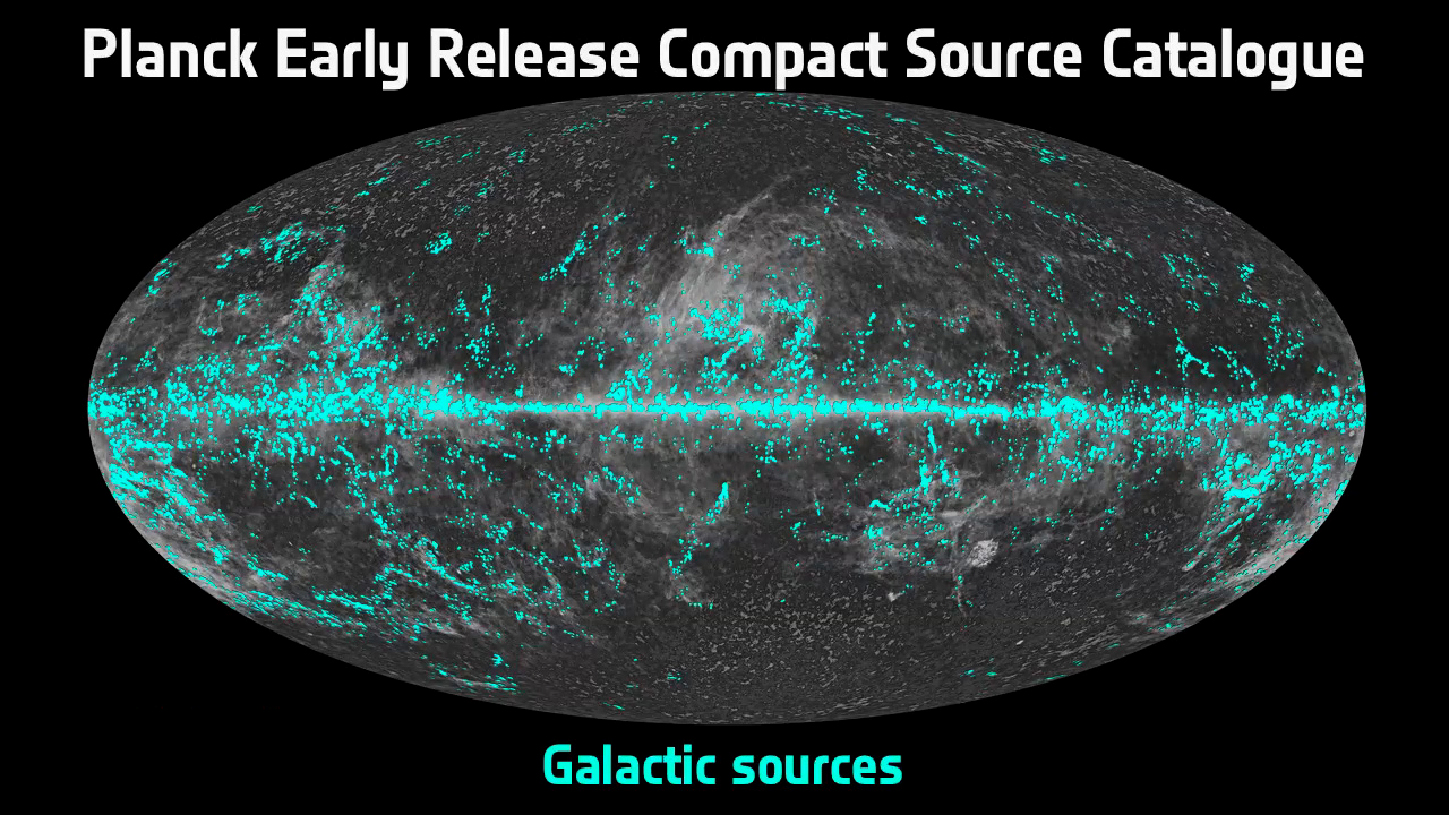
All-sky distribution of galactic sources in the ERCSC


Date: 11 Jan 2011
Satellite: Planck
Depicts: All-sky distribution of galactic sources in the ERCSC
Copyright: ESA/Planck Collaboration
This image illustrates the position on the sky of all galactic sources detected by Planck during its first all-sky survey and listed in the Early Release Compact Source Catalogue (ERCSC).
This sample of compact sources includes features in the galactic interstellar medium, cold molecular cloud cores, and stars with dust shells. In particular, a dedicated resource, the Early Cold Cores Catalogue, comprising 915 molecular cloud cores with temperature cooler than 14 Kelvin, has been made publicly available along with the ERCSC.
The size of the spots displayed in the image reflects the brightness of the sources.

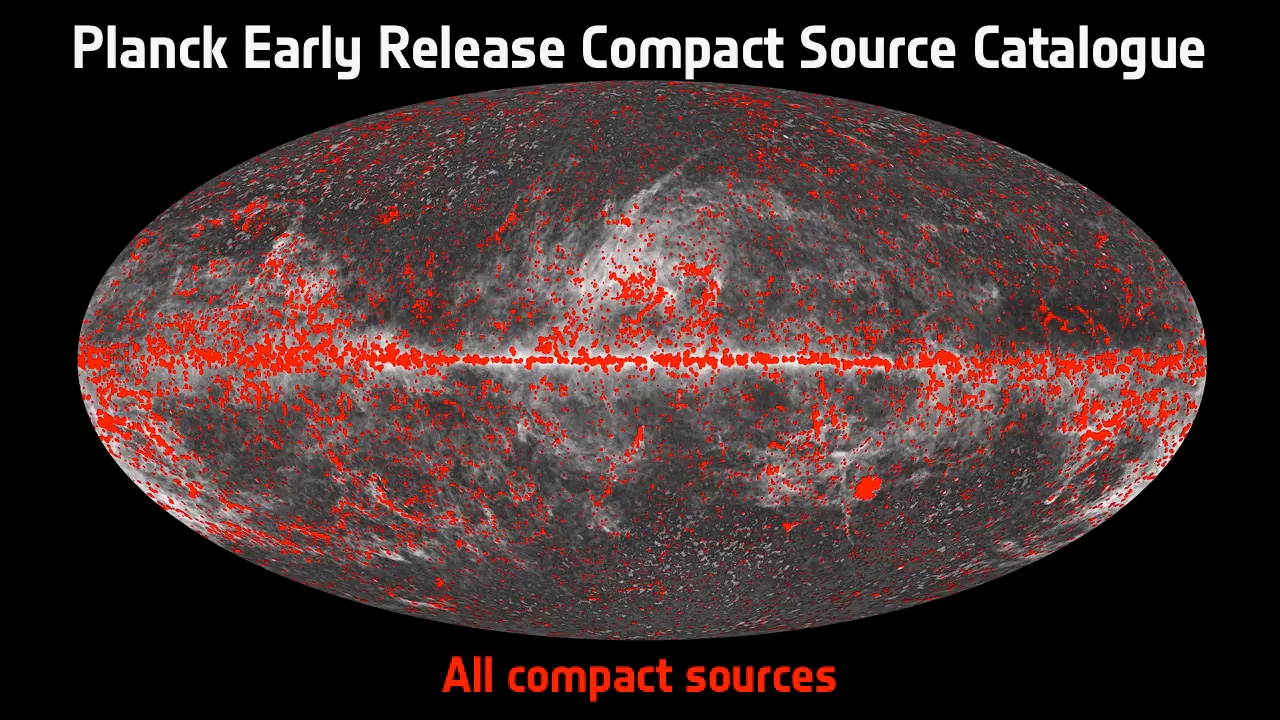
All-sky distribution of all compact sources in the ERCSC


Date: 11 Jan 2011
Satellite: Planck
Depicts: Compact Sources
Copyright: ESA/Planck Collaboration
This image illustrates the position on the sky of all compact sources detected by Planck during its first all-sky survey and listed in the Early Release Compact Source Catalogue (ERCSC).
The ERCSC contains more than 15,000 unique compact sources. These sources have been extracted from the individual lists of sources detected at each of the frequencies probed by Planck by applying a specific set of criteria which identify single sources from sources in the individual lists which are at the same location and at adjacent frequencies.
The size of the spots displayed in the image reflects the brightness of the sources.
The ERCSC comprises a wide variety of astronomical objects, both galactic (features in the galactic interstellar medium, cold molecular cloud cores, stars with dust shells) and extragalactic (radio galaxies, blazars, infrared-luminous galaxies, and galaxy clusters), and it represents a rich and robust database for the entire astronomical community.

Friday, November 18, 2011

Danger! Falling Rocks: Meteorites and Asteroids

Is the New Physics Here? Atom Smashers Get an Antimatter Surprise


By lt | LiveScience.com 
The world's largest atom smasher, designed as a portal to a new view of physics, has produced its first peek at the unexpected: bits of matter that don't mirror the behavior of their antimatter counterparts.
The discovery, if confirmed, could rewrite the known laws ofparticle physics and help explain why our universe is made mostly of matter and not antimatter.
Scientists at the Large Hadron Collider, the 17-mile (27 km) circular particle accelerator underground near Geneva, Switzerland, have been colliding protons at high speeds to create explosions of energy. From this energy many subatomic particles are produced.
Now researchers at the accelerator's LHCb experiment are reporting that some matter particles produced inside the machine appear to be behaving differently from their antimatter counterparts, which might provide a partial explanation to the mystery of antimatter. [The Coolest Little Particles in Nature]
Missing antimatter
Scientists think the universe started off with roughly equal amounts of matter and antimatter. (Particles of antimatter have the same mass of their twins but an opposite charge.) Somehow over the ensuing 14 billion years, most of the antimatter was destroyed, leaving a leftover universe of mainly matter.
One potential explanation for this outcome is called "charge-parity violation."  CP violation means that particles of opposite charge behave differently from one another.
The LHCb researchers found preliminary evidence that this is happening when particles called D-mesons, which contain "charmed quarks," decay into other particles. The whimsically named charmed quarks, like many exotic particles, are so unstable, they last only a fraction of a second. They quickly decay into other particles, and it is these products that the experiment detects. ("LHCb" is short for LHC-beauty, another flavor of quark.)
From the experiment, the researchers found a 0.8 percent difference in the probabilities that the matter and antimatter versions of these particles would decay into a particular end state.
Ruling out a fluke
When it comes to particle physics, it's all about the quality of statistics. Measuring something once is meaningless because of the high degree of uncertainty involved in such exotic, small systems. Scientists rely on taking measurements over and over again — enough times to dismiss the chance of a fluke.
The new finding ranks as a "3.5 sigma" result, meaning the statistics are solid enough that there is only a 0.05 percent likelihood that the pattern they see isn't really there. For something to count as a true discovery in particle physics, it must reach a 5 sigma level of confidence.
"It's certainly exciting, and certainly worth pursuing," LHCb researcher Matthew Charles of England's Oxford University told LiveScience. "At this point it's a tantalizing hint. It's evidence of something interesting going on, but we're keeping the champagne on ice, let's say."
By the end of 2012, Charles said, the Large Hadron Collider should have collected enough data to either confirm or reject the result.
LHC's birthright
If the finding is borne out, it would be a big deal, because it would mean the reigning theory of particle physics, called the Standard Model, is incomplete. Currently the Standard Model does allow for some minor CP violation, but not at the level of 0.8 percent. To explain these results, scientists would have to alter their theory or add some new physics to the existing picture.
In either case, the LHC would have begun to claim its birthright.
"The whole driving purpose of the LHC is to discover and understand new physics beyond the Standard Model," Charles said. "This sort of analysis is exactly why I joined LHCb."
One possible example of the kind of new physics that might explain such CP violation is called supersymmetry. This theory suggests that in addition to all the known particles, there aresupersymmetric partner particles that differ by half a unit of spin. Spin is one of the fundamental characteristics of elementary particles.
So far, no one has found direct evidence of supersymmetry. But if supersymmetric particles exist, they might be created instantaneously and disappear again during the particle-decay process. That way they could interfere with the decay process, potentially explaining why matter and antimatter decay differently.
Charles reported the LHCb team's findings this week in Paris at the Hadron Collider Physics Symposium.

Thursday, November 17, 2011

The cool clouds of Carina

The cool clouds of Carina

Observations made with the APEX telescope in submillimeter-wavelength light at a wavelength of 870 µm reveal the cold dusty clouds from which stars form in the Carina Nebula. This site of violent star formation, which plays host to some of the highest mass stars in our galaxy, is an ideal arena in which to study the interactions between these young stars and their parent molecular clouds. The APEX observations, made with its LABOCA camera, are shown here in orange tones, combined with a visible light image from the Curtis Schmidt telescope at the Cerro Tololo Interamerican Observatory. The result is a dramatic, wide-field picture that provides a spectacular view of Carina's star formation sites. The nebula contains stars equivalent to over 25,000 suns, and the total mass of gas and dust clouds is that of about 140,000 suns. Credit: ESO/APEX/T. Preibisch et al. (Submillimetre); N. Smith, University of Minnesota/NOAO/AURA/NSF (Optical) <

Magnetic fields set the stage for the birth of new stars


Magnetic fields set the stage for the birth of new stars

Image of the Triangulum Galaxy M33, which presents astronomers with a bird’s eye view of its disk. The pink blobs are regions containing newly formed stars. Credit: Thomas V. Davis (tvdavisastropics.com)
(PhysOrg.com) -- Astronomers at the Max Planck Institute for Astronomy have, for the first time, measured the alignment of magnetic fields in gigantic clouds of gas and dust in a distant galaxy. Their results suggest that such magnetic fields play a key role in channeling matter to form denser clouds, and thus in setting the stage for the birth of new stars. The work will be published in the November 24 edition of the journal Nature.
Stars and their planets are born when giant clouds of interstellar gas and dust collapse. You've probably seen the resulting stellar nurseries in beautiful astronomical images: Colorful nebulae, lit by the bright  they have brought forth.
 know quite a bit about these so-called molecular clouds: They consist mainly of  – unusual in a cosmos where conditions are rarely right for hydrogen atoms to bond together into molecules. And if one traces the distribution of clouds in a spiral galaxy like our own Milky Way galaxy, one finds that they are lined up along the spiral arms.
But how do those clouds come into being? What makes matter congregate in regions a hundred or even a thousand times more dense than the surrounding ?
One candidate mechanism involves the galaxy's magnetic fields. Everyone who has seen a magnet act on iron filings in the classic classroom experiment knows that magnetic fields can be used to impose order. Some researchers have argued that something similar goes on in the case of molecular clouds: that galaxies' magnetic fields guide and direct the condensation of interstellar matter to form denser clouds and facilitate their further collapse.
Some astronomer see this as the key mechanism enabling star formation. Others contend that the cloud matter's gravitational attraction and turbulent motion of gas within the cloud are so strong as to cancel any influence of an outside .
If we were to restrict attention to our own galaxy, it would be difficult to find out who is right. We would need to see our galaxy's disk from above to make the appropriate measurements; in reality, our Solar System sits within the galactic disk. That is why Hua-bai Li and Thomas Henning from the Max Planck Institute for Astronomy chose a different target: the Triangulum galaxy, 3 million light-years from Earth and also known as M 33, which is oriented in just the right way.
Using a telescope known as the Submillimeter Array (SMA), which is located at Mauna Kea Observatory on Mauna Kea Island, Hawai'i, Li and Henning measured specific properties of radiation received from different regions of the galaxy which are correlated with the orientation of these region's magnetic fields. They found that the magnetic fields associated with the galaxy's six most massive giant molecular clouds were orderly, and well aligned with the galaxy's spiral arms.
If turbulence played a more important role in these clouds than the ordering influence of the galaxy's magnetic field, the magnetic field associated with the cloud would be random and disordered.
Thus, Li and Henning's observations are a strong indication that magnetic fields indeed play an important role when it comes to the formation of dense – and to setting the stage for the birth of stars and planetary systems like our own.
More information: The work described here will be published in the November 24, 2011 edition of Nature as H. Li and T. Henning, "The alignment of molecular cloud magnetic fields with the spiral arms in M33". The article will be published online on November 16. Link to article: http://dx.doi.org/ … /nature10551
Provided by Max-Planck-Gesellschaft (news : web)

Will Red Planet rover send groundbreaking data over?


November 16, 2011 By Mike Anton
Mars rover Curiosity

An artist's concept illustrates what the Mars rover Curiosity will look like on Mars. Credit: NASA/JPL-Caltech.
One of the most sophisticated space vehicles ever made inches along the rocky landscape, aluminum wheels grinding like a spoon in a garbage disposal.

Here in the Mars Yard at the Jet Propulsion Laboratory, what passes for the Red Planet looks like a vacant lot in Hesperia. The vehicle being tested, a replica of the latest Mars rover that will soon be crawling around up there, looks like a giant mechanical insect - six wheeled legs, an articulating arm and a pair of blue camera lenses like eyes peering from a boxy head.
This month, NASA's most ambitious Mars rover mission to date is scheduled to lift off from Cape Canaveral, Fla., aboard an Atlas V rocket. It's a $2.5 billion gamble scientists hope will give unparalleled insights into how Mars evolved and whether it ever could have supported life.
The Mars Science Laboratory - nicknamed Curiosity - was developed at JPL in La Canada Flintridge, Calif., and will be the fourth rover to traverse the planet's harsh terrain. But unlike the earlier  - Sojourner, Spirit and the still-cruising Opportunity - Curiosity will do more than look for evidence of water.
Curiosity is a robot . During a mission expected to last at least two years, the rover will use a battery of scientific instruments to analyze Mars' geology and atmosphere, looking for the elements and  that are the building blocks of life.
Scientists hope the information Curiosity gathers will exponentially increase their understanding of Mars and bring us closer to answering the most profound and tantalizing of questions: Could life exist beyond Earth?
"Humans are hard-wired to want to know the answer to that," said Bill Nye, executive director of the Planetary Society, the Pasadena, Calif.-based nonprofit that advocates for space exploration. "If we found life on Mars, it would change everybody's view of our place in space."
Curiosity will take 8.5 months to travel the 354 million miles to Mars - and two years to cover about 14 miles of its surface. 
Irisys Camera buy online - Official Irisys Camera Stockist Thermal imaging, reporting software - www.edcscotland.co.uk
The rover is expected to land Aug. 5 near the Martian equator inside Gale crater, a chasm about the combined size of Connecticut and Rhode Island with a three-mile-high mountain of layered sedimentary rock at its bottom.
Scientists believe the crater, thought to date back billions of years to when Mars was warm and wet, will reveal the planet's evolutionary story the way the Grand Canyon's strata expose the history of Earth.
"It's going to be like reading a novel - and it's a long one," said John Grotzinger, the project's chief scientist. "It's going to be a wild journey looking into the guts of the history of Mars."
If Curiosity were a car, it would be advertised as fully loaded: six aluminum wheels that can be steered independently. A mounted laser to vaporize rock. Seventeen cameras to take high-definition images, scientific measurements and navigate the rover. A robotic arm to drill into rock and scoop up samples. Instruments to detect in those samples organic compounds and elements associated with life on Earth.
And under the hood: a nuclear-powered engine that will give Curiosity a top crawling speed of 2 inches per second.
All that hardware gives the rover a curb weight of a ton. That's five times heavier than its predecessor, which bounced along the Martian surface nestled inside huge protective air bags before coming to rest, like a beach ball tossed from a low-flying airplane.
"The air bags needed to land Curiosity would have been two or three times the weight of the rover itself," said Adam Steltzner, a JPL engineer in charge of ensuring the rover lands in one piece. "There's no landing rocket that could have handled that weight."
So Steltzner's team has engineered an innovative, multi-staged system that, unlike the beach ball approach, will use sensors and advanced computer software to guide Curiosity's descent to a relatively pinpoint landing.
As planned, the craft carrying the rover will hit Mars' atmosphere at 13,000 mph. Thruster rockets will slow and steer the craft, positioning it for landing. At about 1,000 mph, a parachute will deploy and slam on the brakes. Finally, a "sky crane" will emerge from the craft's descent stage and gently lower a tethered Curiosity to the ground.
All this in just six minutes.
"It looks kind of crazy. And it's definitely novel," Steltzner said. "But we believe it to be a very simple process."
A lot is at stake.
The Curiosity rover is one of most complex projects in NASA's history. It's also $900 million over budget and two years late.
An audit released earlier this year by NASA's inspector general criticized managers for repeatedly underestimating the cost of working around the project's numerous technological hurdles - a common complaint of the agency through the years.
All this comes at a time of budget cutting at NASA and a lack of consensus among scientists and politicians as to where the U.S. space program ought to devote dwindling dollars.
"If this fails, it's going to be a disaster," said Nye of the Planetary Society. "Congress will become ever less trusting of the true costs of these missions and the ability of the people doing it."
But Nye says the 26-month delay has a huge upside: it reduced the risk of failure.
"Everyone involved is working very hard to make sure that this succeeds," he said.
The sky crane landing system is key to a more ambitious future mission: a planned partnership with the European Space Agency to send a rover to collect rock and soil on Mars and cache the samples for an eventual return to Earth.
"There's no such thing as a perfect landing system on Mars," said Steve Squyres, lead scientist for the Spirit and Opportunity rovers. "It's a highly unpredictable environment. It's always possible that a gust of wind or a pointy rock could ruin your day."
The hold of Mars on the imagination of humans is eternal.
The ancients viewed the Red Planet with the naked eye and imbued it with the spirit of war. Galileo was the first to study Mars through a telescope. Novelists imagined civilizations of green men more advanced - and dangerous - than those on Earth.
"The death agonies of a fellow being are, to these strange creatures, provocative of the wildest hilarity," Edgar Rice Burroughs wrote a century ago in "A Princess of Mars," "while their chief form of commonest amusement is to inflict death on their prisoners of war in various ingenious and horrible ways."
Over the last 50 years, more orbiters, probes and rovers have been flung at Mars than any other corner of the cosmos except our moon.
Getting there isn't easy. About half of the dozens of spacecraft sent to Mars have either malfunctioned, crashed or disappeared.
Because it's the only planet in our solar system that could have sponsored life - the rest are too hot, too cold or made of gas - public expectations of early trips to Mars were so high that the results seemed disappointing even when the missions succeeded.
In 1965, when Mariner 4 sent back the first extraordinary close-up pictures of the Martian surface, thoughts of "green men" and cities abruptly came to an end.
"Hope that a future astronaut might someday find life on Mars faded deeper than ever into science fiction," Time magazine glumly reported at the time. "The bleak, pocked surface of the red planet looked dead indeed."
In the years since, Mars missions have methodically built a scientifically rigorous portrait of the planet that offer insights on Earth's early history and future.
"Going from a living Mars to a dead Mars set the agenda of missions for years to come," said John Grunsfeld, a former astronaut and chief scientist for NASA who is now deputy director of the Space Telescope Science Institute. "We focused on basic science, how planets are formed and what that says about Earth."
With this in mind, JPL scientists are downplaying the likelihood that Curiosity might actually find organic matter - a key ingredient for life. Finding conditions that would signal that Mars once could have supported life would be breathtaking in itself.
"You can't promise more than you can deliver. That's what happened" before, said Grotzinger, the mission's chief scientist, a geologist new to the space game.
As wet sediment hardens to rock, organic material is destroyed. Finding even a shred of the stuff in early Earth rocks is extremely rare, Grotzinger said.
Detecting organic matter in one narrow stretch of Mars shouldn't define whether Curiosity is a success, Grotzinger said.
"This is like looking for a needle in haystack - and the haystack is the size of," he said. "But that doesn't mean we won't try."
(c)2011 the Los Angeles Times 
Distributed by MCT Information Services

Monday, November 14, 2011

PhysOrg Newsletter Week 45

(PhysOrg.com) -- Italian scientist Andrea Rossi has spent the past year giving demonstrations of a device that he claims can generate large amounts of energy due to a little-understood nuclear process. His latest demonstration, performed on October 28th, has attracted some of the most mainstream media attention yet, with coverage by outlets including Fox News, Forbes, and MSNBC, among others. But the big question still seems to be whether Rossi’s E-Cat (energy catalyzer) device is a huge breakthrough or a huge scam. What’s making the answer so difficult to determine is the lack of a clear, scientific explanation of what exactly is going on.
High-voltage engineers create nearly 200-foot-long electrical arcs using less energy than before (Update)
Photos taken by the researchers show plasma arcs up to 60 meters long casting an eerie blue glow over buildings and trees at the High Voltage Laboratory at the University of Canterbury in New Zealand.
Research sparks record-breaking solar cell performances
(PhysOrg.com) -- Theoretical research by scientists with the U.S. Department of Energy (DOE)’s Lawrence Berkeley National Laboratory (Berkeley Lab) has led to record-breaking sunlight-to-electricity conversion efficiencies in solar cells. The researchers showed that, contrary to conventional scientific wisdom, the key to boosting solar cell efficiency is not absorbing more photons but emitting more photons.
A revolution in knot theory
In the 19th century, Lord Kelvin made the inspired guess that elements are knots in the "ether". Hydrogen would be one kind of knot, oxygen a different kind of knot---and so forth throughout the periodic table of elements. This idea led Peter Guthrie Tait to prepare meticulous and quite beautiful tables of knots, in an effort to elucidate when two knots are truly different. From the point of view of physics, Kelvin and Tait were on the wrong track: the atomic viewpoint soon made the theory of ether obsolete. But from the mathematical viewpoint, a gold mine had been discovered: The branch of mathematics now known as "knot theory" has been burgeoning ever since.
Voyager 2 to switch to backup thruster set
(PhysOrg.com) -- NASA's Deep Space Network personnel sent commands to the Voyager 2 spacecraft Nov. 4 to switch to the backup set of thrusters that controls the roll of the spacecraft. Confirmation was received today that the spacecraft accepted the commands. The change will allow the 34-year-old spacecraft to reduce the amount of power it requires to operate and use previously unused thrusters as it continues its journey toward interstellar space, beyond our solar system.
Methane may be answer to 56-million-year question
(PhysOrg.com) -- The release of massive amounts of carbon from methane hydrate frozen under the seafloor 56 million years ago has been linked to the greatest change in global climate since a dinosaur-killing asteroid presumably hit Earth 9 million years earlier. New calculations by researchers at Rice University show that this long-controversial scenario is quite possible.
How old is the Earth's core? Maybe older than you thought
(PhysOrg.com) -- Another discovery by a Michigan Technological University researcher could send shockwaves across the world of earth science.
World has five years to avoid severe warming: IEA
The world has just five years to avoid being trapped in a scenario of perilous climate change and extreme weather events, the International Energy Agency (IEA) warned on Wednesday.
New materials turn heat into electricity
Most of today's power plants--from some of the largest solar arrays to nuclear energy facilities--rely on the boiling and condensing of water to produce energy.
Was the real discovery of the expanding universe lost in translation?
(PhysOrg.com) -- The greatest astronomical discovery of the 20th century may have been credited to the wrong person. But it turns out to have been nobody's fault except for that of the actual original discoverer himself.
Giant planet ejected from the solar system
(PhysOrg.com) -- Just as an expert chess player sacrifices a piece to protect the queen, the solar system may have given up a giant planet and spared the Earth, according to an article recently published in The Astrophysical Journal Letters.
Breakthrough scientific discoveries no longer dominated by the very young: study
Scientists under the age of 40 used to make the majority of significant breakthroughs in chemistry, physics and medicine – but that is no longer the case, new research suggests.
Physicists chip away at mystery of antimatter imbalance
(PhysOrg.com) -- Why there is stuff in the universe—more properly, why there is an imbalance between matter and antimatter—is one of the long-standing mysteries of cosmology. A team of researchers working at the National Institute of Standards and Technology has just concluded a 10-year-long study of the fate of neutrons in an attempt to resolve the question, the most sensitive such measurement ever made. The universe, they concede, has managed to keep its secret for the time being, but they’ve succeeded in significantly narrowing the number of possible answers.
Weird world of water gets a little weirder with a new anomaly
Strange, stranger, strangest! To the weird nature of one of the simplest chemical compounds -- the stuff so familiar that even non-scientists know its chemical formula -- add another odd twist. Scientists are reporting that good old H2O, when chilled below the freezing point, can shift into a new type of liquid. The report appears in ACS' Journal of Physical Chemistry B.
Russia aims for first conquest of Mars
Russia on Wednesday launches a probe for Mars that aims to collect a chunk of a Martian moon and become Moscow's first successful planetary mission since the collapse of the Soviet Union.
2012: Killer solar flares are a physical impossibility
(PhysOrg.com) -- Given a legitimate need to protect Earth from the most intense forms of space weather – great bursts of electromagnetic energy and particles that can sometimes stream from the sun – some people worry that a gigantic "killer solar flare" could hurl enough energy to destroy Earth. Citing the accurate fact that solar activity is currently ramping up in its standard 11-year cycle, there are those who believe that 2012 could be coincident with such a flare.
High court troubled by warrantless GPS tracking (Update)
The Supreme Court invoked visions of an all-seeing Big Brother and satellites watching us from above. Then things got personal Tuesday when the justices were told police could slap GPS devices on their cars and track their movements, without asking a judge for advance approval.
Professor was right: Mastodon weapon was older than thought, scientists say
It's not unusual for an archaeologist to get stuck in the past, but Carl Gustafson may be the only one consumed by events on the Olympic Peninsula in 1977.
Researchers unravel the mystery of quantum dot blinking
(PhysOrg.com) -- Research by Los Alamos scientists published today in the journal Nature documents significant progress in understanding the phenomenon of quantum-dot blinking. Their findings should enhance the ability of biologists to track single particles, enable technologists to create novel light-emitting diodes and single-photon sources, and boost efforts of energy researchers to develop new types of highly efficient solar cells.
Autism linked with excess of neurons in prefrontal cortex
A study by researchers at the University of California, San Diego Autism Center of Excellence shows that brain overgrowth in boys with autism involves an abnormal, excess number of neurons in areas of the brain associated with social, communication and cognitive development.